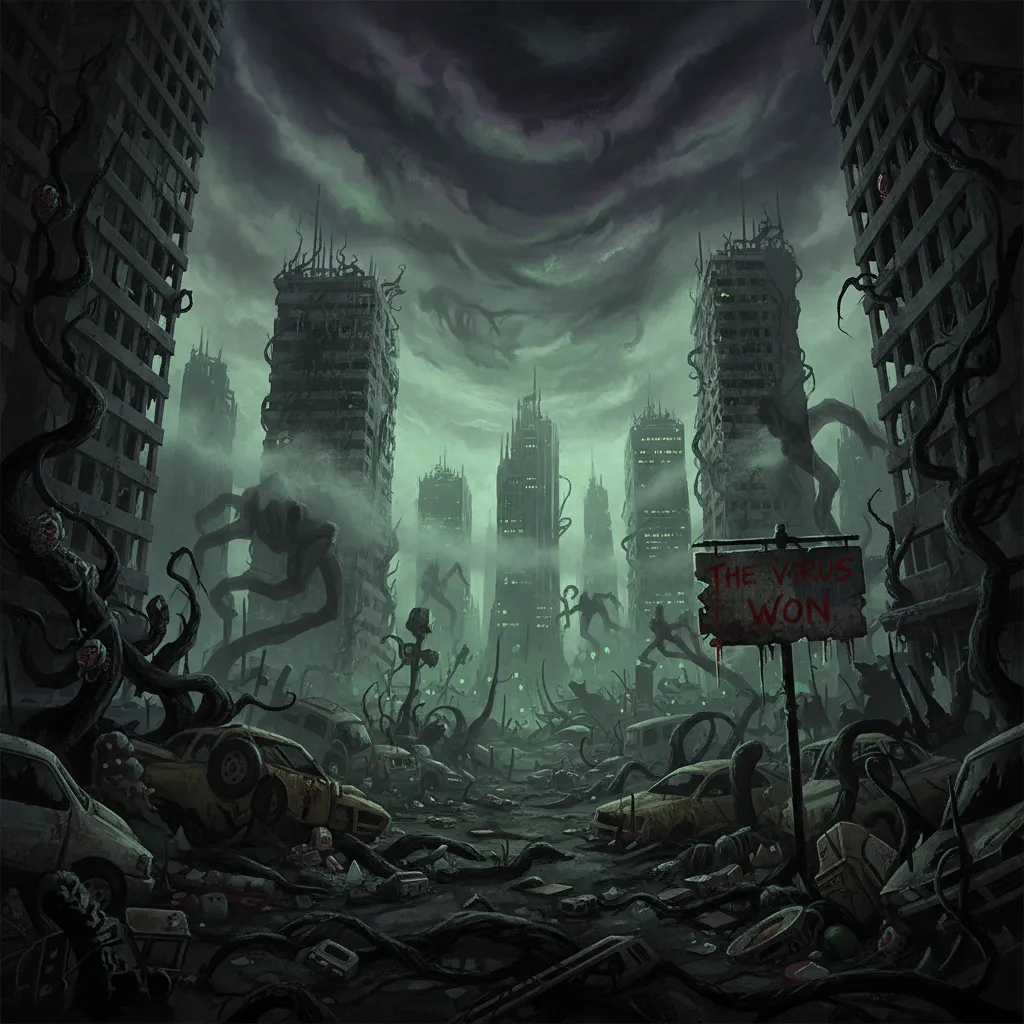
This piece dives into the anxiety of ultimate failure, presenting the end not as a dramatic explosion, but as a slow, corrosive dissolution of meaning. It uses the metaphor of a "virus winning" to explore themes of modern dread, the breakdown of societal comfort, and the bleak, unsettling humor found at the heart of cosmic indifference. The tone is frantic and accusatory, challenging the reader's expectation of progress.
The Virus Won
The virus won. The plague was not fire or fever, but pure digestion and elimination of the Fat, dissolving the plush absurdity of the bloated world, and all that's left is the residue—the bubbling glow worm of the soul and the crooked half-smiles etched onto bone, and there is isn't much time left, only the desperate measurement of distance, counting chicken scratch along tombstones, and if time was merely that, a ledger of meaningless marks, then no one would be forced to see the mess for what it is—a catastrophic, final mess.
Finite time on a finite planet, rushing toward the cold, certain silence where Oblivion tells a story—not a whisper, but a screaming, grinding puppet theater staged with clubs and chainsaws, a vaudeville of violence where no one is beyond disintegration, where no one, regardless of creed or calculus, is beyond the final pull of the void. The Virus Won, and did you see the South Park special? Who the hell knew the world would end with laughter, as if something tied the knot—the ultimate cosmic gag grafting meaning to the unraveling universe—was merely fodder for the Marx Brothers, a custard pie to the face of the Apocalypse.
The question echoes in the void: Did the patient die curing the wound? What is left? Not redemption, but a new thing, a new person—some entity thing cognitively birthed to the same, unyielding, and brutal universe which allows no winning pathology, only the exquisite, hilarious torment of understanding that the only path forward is the one leading straight into the dark.
Conclusion:
The poem concludes not with finality, but with transformation—the creation of a "new person" or "entity" born from the realization that existence itself is inherently brutal and without a successful blueprint. This closing thought locks the speaker into a state of perpetual, conscious suffering, framed by the universe's ultimate indifference, making the acceptance of non-meaning the poem's final, devastating insight.
Comments
Post a Comment