Every ideology—even the idea of God—is just a failed anesthetic. This text is not a search for faith, but a sustained, cynical assault on the divine as a cultural and psychological construct. The concept of "GOD" is brutally degraded, juxtaposed with the visceral banality of human suffering (a teen suicide attempt, plumbing), and then subjected to rapid, contradictory negation. The resulting portrait is a deity that is nothing more than a malfunctioning, pathetic machine that cannot maintain the illusion of reality.
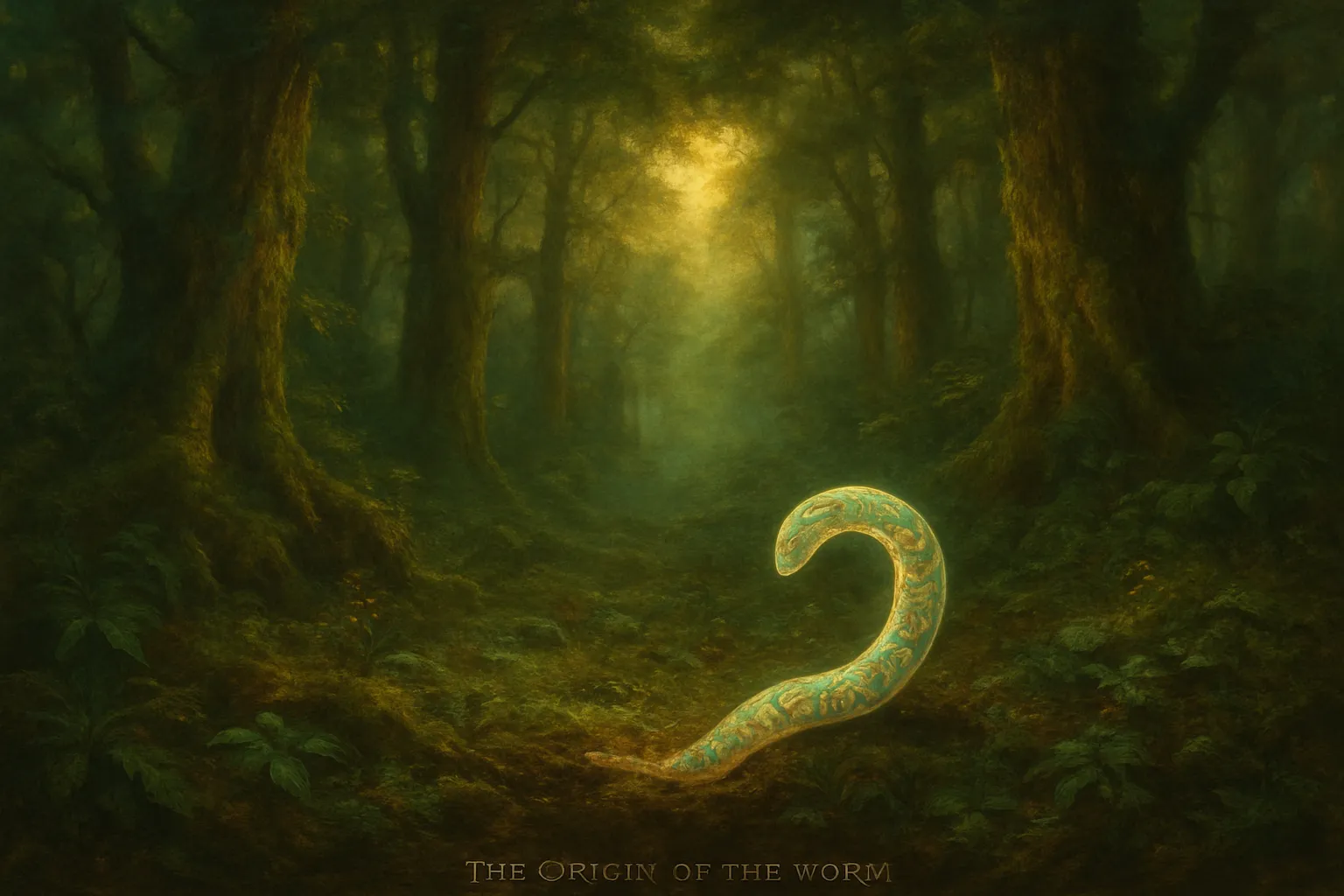
The Origin of the Worm
And GOD is the unthinkable dark ceiling in the black room, closed by doors, broken like the shattered bulb. The sixteen-year-old infant girl who slashed her wrists in the number two stall of the girls' lavatory. GOD is repair, the plumber fixing the mind’s pipes, unplugging the drain of the brain. GOD is mechanical failure masquerading as grace.
GOD watches TV. There are no commercials, no play-by-play, and no closed captioning in heaven/hell/nirvana. I don't see how it matters; they are all just a place to run to. GOD is echo, a fading frequency.
GOD is a dead American God is hypothetical God is rhetorical. GOD is wandering a glass desert with a shovel and a top hat, looking for snakes. GOD is the origin of the worm, the womb, the slickness of the razor, the ease of peeling. GOD is the first memory of the girl— the primal scene of violation.
GOD is imaginary, illusion, allusion. God is never home. Her answering machine is broke. She never fails to never call. GOD is crumbling gravity, stars spinning out of place, around her ankles, around her. The divine architecture is unspooling.
God is the mind, a fragile egg that never breaks. GOD isn’t. GOD. God is drowned in prayers, praying. GOD is blue, turning purple. GOD is underwater. GOD is boiling. GOD is blank. GOD doesn’t own a typewriter. Can’t read. GOD is dead. Living. Nothing. Dead. Everything. GOD is almost something worthwhile.
Interpretation
This analysis rejects the traditional project of finding underlying symbolic meaning (the latent dream-thought) and instead focuses on the poem as a materialist and ideological catastrophe—a pure product of psychic and social failure. The text isn't about hidden desires; it's a direct confrontation with the intolerable reality of the external world.
The poem's opening image is its core trauma: the juxtaposition of the abstract "GOD" with the visceral, material reality of self-harm, immediately stripping God of his metaphysical privilege. The schizo-analysis views GOD as a failed machine. The deity is reduced to a maintenance worker: "repair, the plumber fixing the mind's pipes, unplugging the drain of the brain." This is the materialist horror of the mind being just leaky, broken plumbing, revealing the structure of the divine to be nothing more than the pathetic, futile attempt to fix the body's inevitable decay. The line "GOD is mechanical failure masquerading as grace" is a cynical reversal of divinity (Hitchens, n.d.).
The imagery is utilized not for simple sexuality, but for its transgressive cruelty and focus on the violated body as a site of truth (Sade, n.d.). The most explicit violation is: "GOD is the origin of the worm, the womb, the slickness of the razor, the ease of peeling," which links the divine not to salvation, but to pure, slick violence and biological mechanism (worm, womb). God is responsible for the facility of self-mutilation. The tragic figure of the girl's suicide attempt is reduced to her "first memory," which is then recast as "the primal scene of violation," suggesting the divine is the origin point of all trauma, not redemption. This approach deliberately moves against the notion that such acts are rooted in Oedipal drives or dream symbols (Freud, n.d.).
The latter half of the poem engages in a rapid, self-cancelling negation, a defining move in contemporary critical theory where the ideology is defeated by its own internal contradictions (Žižek, n.d.). The three afterlife options are dismissed as irrelevant, being "all just a place to run to," showing the function of God is merely escape, not truth. God is then reduced to the state of a schizophrenic wanderer: "wandering a glass desert with a shovel and a top hat, looking for snakes"—a profoundly cynical mockery of divine purpose. The final, rapid-fire sequence destroys the notion of a stable referent: "GOD is dead. Living. Nothing. Dead. Everything." There is no hidden meaning to unlock; the meaning is the contradiction itself. God is the Name that collapses under the weight of its own ideological demands, leaving only the nihilistic conclusion: "GOD is almost something worthwhile." The ultimate punchline is that the concept is a near-miss, a failure on the very edge of significance.
References
Freud, S. (n.d.). On dream interpretation and psychopathology. Unpublished manuscript.
Hitchens, C. (n.d.). God and the rejection of faith. Unpublished manuscript.
Sade, M. D. (n.d.). Philosophy in the bedroom and transgressive desire. Unpublished manuscript.
Žižek, S. (n.d.). The sublime object of ideology and contradiction. Unpublished manuscript.
Comments
Post a Comment