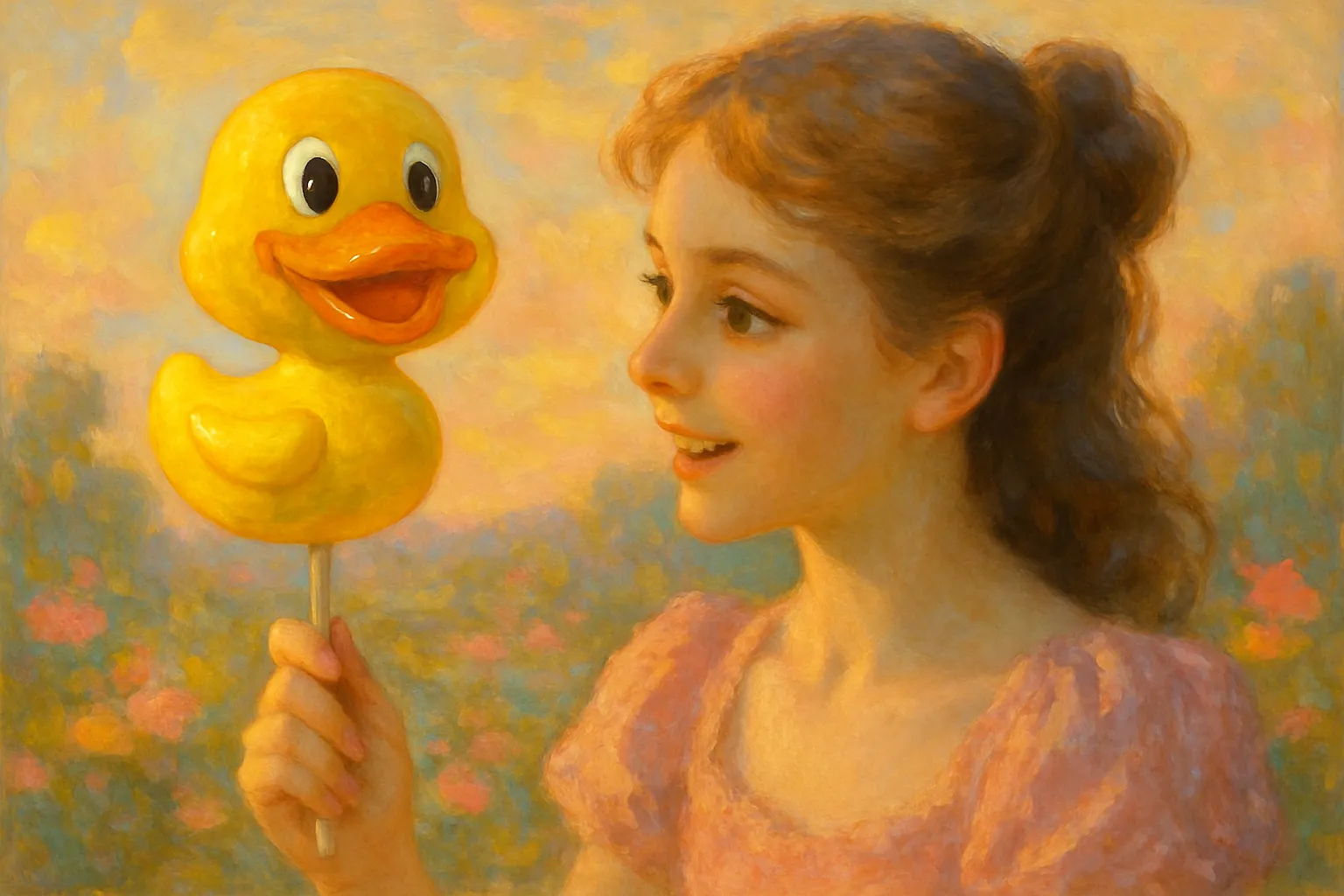
Every object in this room is a weapon, and every action is a calculated act of corruption. This text frames a tense, intimate encounter where the narrator is already retreating, leaving only fragments ("what was left of me") for the consumption of "She." The objective, clean imagery is twisted by a narrative of patient, willful destruction—the total consumption of an innocent symbol (the happy duck) as an aesthetic, perverse project. The discovery of crayons at the end is the final, pathetic affirmation of arrested development and an inability to deal with the adult corruption observed.
Happy Duck
I sat across from her. Avoiding her Porcelain Eyes—pure, glazed, unblinking. And sugared thighs—a false promise, a trap.
She leaned forward in her chair. The movement was precise. Propping her chin with her fingers, elbows to the table. Facticity: geometry of desire.
Looking—no, peering— into what was left of me, the empty room behind the eyes.
She took a sucker out of her mouth. The transparent object. It POPPED. The sound was sharp, metallic.
And she told me how she took all day to lick off the image of the happy Duck. The deliberate, slow eradication of innocence; the pleasure of making the symbol bleed.
I leaned back. And discovered Crayons in my Pocket. Red. Blue. Yellow. Unused tools.
Interpretation
This text orchestrates a collision between clinical visual observation and moral corruption, where the narrator’s retreat is a defense against the consuming, destructive force of the female subject.
The initial imagery establishes the clinical, yet threatening, tension. The woman’s features—"Porcelain / Eyes" and "sugared thighs"—are reduced to fetishized objects. The porcelain suggests an unnerving, artificial perfection, while the sugar is a bait, a trap. The narrator's posture of "Avoiding her" and the description of "what was left of me" confirm the subject's deterritorialization; he is already fragmented and retreating from the demanding presence of the Other. The scene is one of stark, observed geometry: elbows to the table, precise leaning.
The destructive project begins with the presentation of the "pin sucker," a sharp, transparent object that highlights the visibility of the corruption. The POP is the sound of the decisive action—the finality of the chosen destructive path. Her confession details a meticulous, willful destruction of innocence: "she took all day to lick off / The image of the happy / Duck." The happy Duck is the symbol of naive, uncorrupted life. Her prolonged, deliberate action transforms the simple act of eating candy into an aestheticized vice, where pleasure is derived from the process of eradicating a pure symbol. This highlights the methodical, intellectualized destruction of moral boundaries.
The narrator's final action is an anticlimax of existential retreat. He leans back, discovering the "Crayons in my / Pocket." The crayons—"Red. Blue. Yellow. Unused tools"—are the symbols of infantile creativity, innocence, and unfulfilled potential. They represent his inability to engage with or counter the profound, complex corruption presented by the woman. He retreats not into a higher truth, but into the safe, passive facticity of his pocketed childhood, leaving him exposed to the consuming power of the female gaze.
Comments
Post a Comment