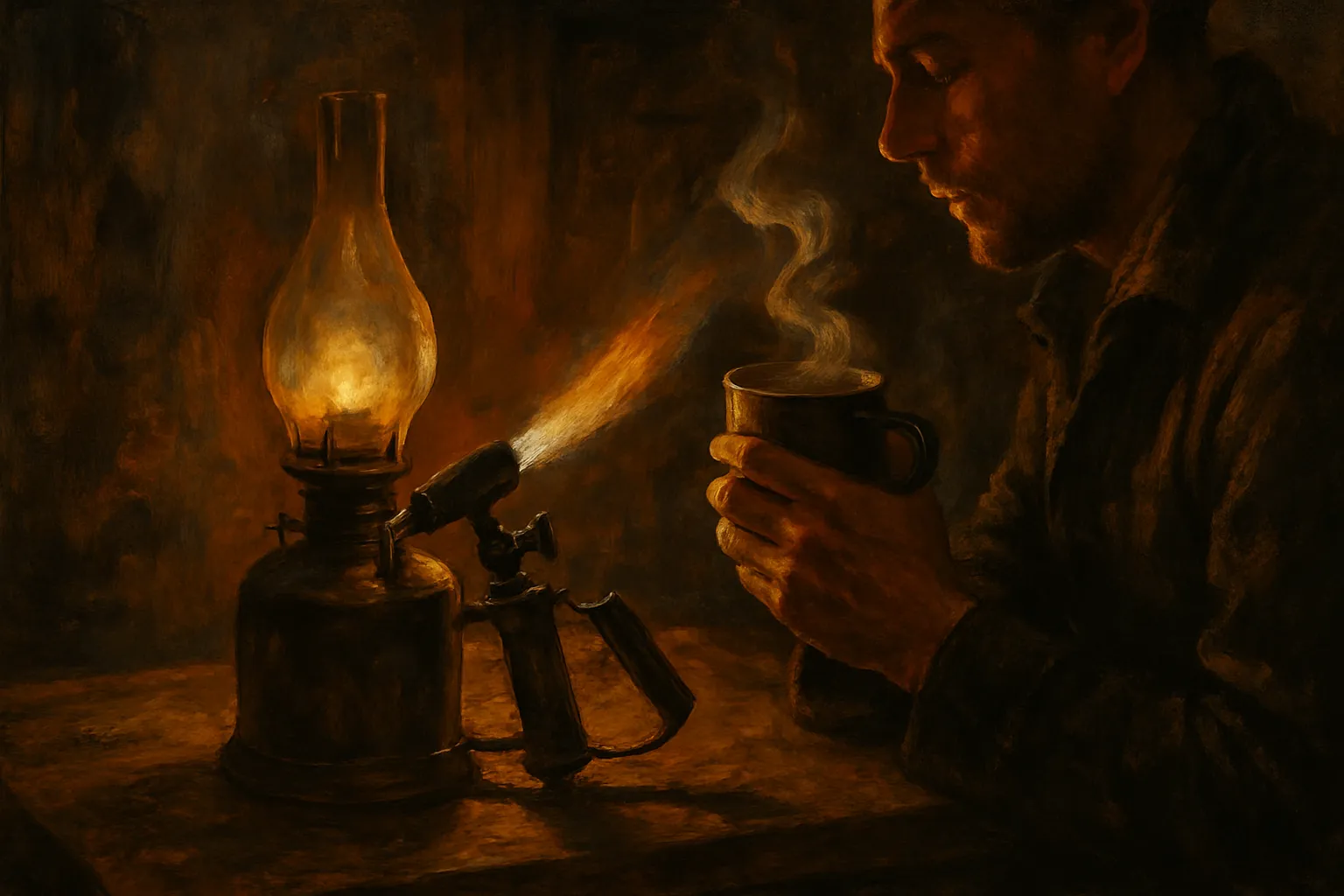
Behold the detonation of consciousness at dawn. This poem is a corrosive sprint through an urban landscape, where the speaker's internal volatility—the "kerosene rustling in the meow"—serves as the necessary fuel for absolute clarity. It rapidly transitions from the apathy of the morning commute to a shocking, final philosophical conclusion. The poem posits that in a world governed by cold, inescapable violence, the most brutal act of all—a shotgun abortion—becomes a perverse, life-affirming gesture of "preemptive grace."
The Kerosene
Fuck coffee eyes, hands-in-pocket mornings,
the slow, stumbling descent down the stairs
before the sun has earned its title. Thoughts
tumble, the unspent currency of the night.
I run now, shedding the drag of those thoughts,
down the cold concrete stairs, feeling the kerosene
rustling in the meow—that low, charged, animal fuel.
It makes the world's cheap necessity visible:
an ambulance shrieks past, a hollow red hysteria,
here only to deliver junk mail to the street.
The world is cold. I see it clearly:
Muggers hide behind the stark, black trees
in parks, waiting to knife the lost children
and the mothers. The violence is always primed.
This is the final, brutal logic the kerosene showed me:
Mothers perform abortions with shotguns—
not to end life, but to save it, to excise the fetus
from the cycle, to protect the child from the abusive father
before it draws breath in his jurisdiction.
A final, preemptive grace born directly
from the cold, chaotic indifference of the dawn.
Interpretation
The poem is structured as a direct output of the subject's Desiring-Machine experiencing an accelerated state of schizophrenic flight, catalyzed by an internal chemical flow. The initial urban setting represents the mundane, alienated socius—the "coffee eyes" and "hands-in-pocket mornings" are codes for passive participation in the system. The internal combustion is signaled by the "kerosene / rustling in the meow"—this phrase is the ignition of the Body without Organs (BwO), where the subject channels volatile, animalistic energy to achieve a state of heightened, non-alienated perception.
The ambulance delivering junk mail is a critical deterritorialization event. The ambulance, a symbol of emergency and necessary system intervention, is revealed to be a mere conveyor of "junk mail"—useless, coded noise. The institutional flow is exposed as a "hollow red hysteria," teaching the subject that necessary systems are corrupt and the state of emergency is permanent and meaningless. This realization validates the narrator’s need for internal "kerosene."
The central realization is the mapping of the world as a place of universal, primed violence ("Muggers hide... waiting to knife"). This is the subject's projection of the underlying systemic hostility. The final, shocking image—the shotgun abortion—is the poem’s climax of anti-Oedipal struggle. The mother's act is not merely violence, but a calculated, inverted act of creation. She is performing a preemptive cut against the flow of the abusive paternal system (the "abusive father") that seeks to claim the child for its own brutal jurisdiction.
By using the shotgun, the mother reclaims the power of the socius (typically represented by state-sanctioned violence) to enact her own, inverted morality. The fetus is excised from the cycle, preventing its territorialization by the abusive father's power structure. This "preemptive grace" is the final, brutal logic born from the cold truth of the dawn: the greatest act of love and protection available to the subject is to destroy the possibility of the child being captured by the corrupting flows of the world. The BwO seeks salvation through negation.
Comments
Post a Comment