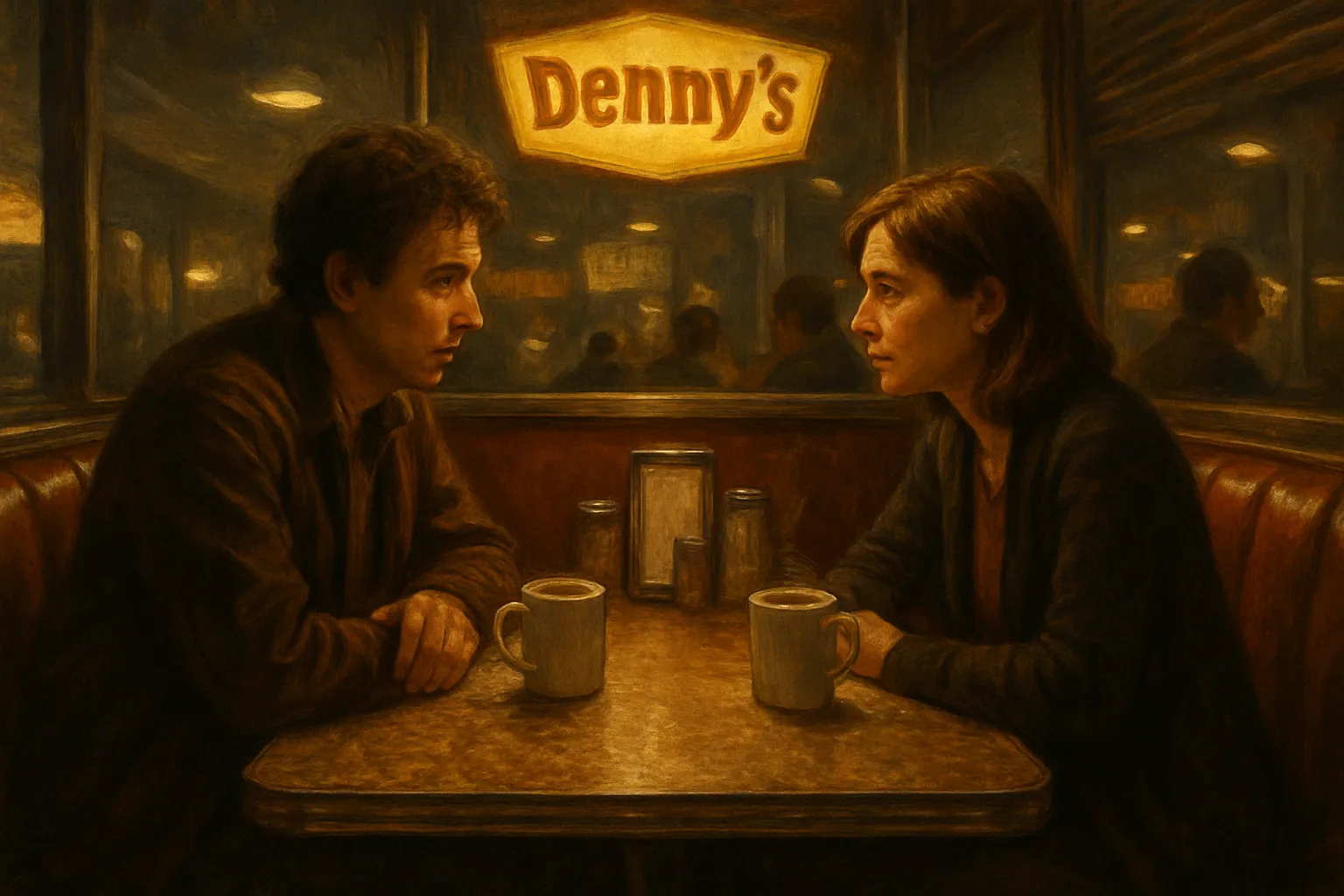
Every social interaction in this poem is a financial debt and every person is a disposable commodity. This poem presents a detached, consumerist tableau of modern youth alienation, where every interaction is reduced to a cold transaction or a mere function of commodity culture. The subjects, identified only by the generic titles Figure A and Figure B, exist within a state of absolute boredom and stasis, waiting for the next prescribed social event (the next year, enlistment). The narrative voice operates outside this transactional loop, registering social exchanges not as emotional events, but as mechanical operations (eyes executing a transaction, thinking of a uniform), culminating in the final, jarring realization of an existential void.
Ask Someone Else
After the movie
in the parking lot,
Mitch and Alicia smoked,
I leaned against the car's tire.
In the car,
they talked of
the next year.
I thought of the uniform,
the absolute machine.
Nirvana played twice
And I sat on the roof
As they
Talked.
At Denny’s
Alicia’s eyes executed a transaction:
If I had locked the door.
I thought of the absence of spirit.
She slipped on her
Black sweatshirt.
The waitress
Asked if
I wanted anything.
I shook my head.
What now? The void opens.
I folded the placemat
And put it in my pocket
Mitch took the ashtray.
The waitress
Asked for her cigarette.
Shoes, duct-taped refusal.
I sat, against the wall.
Cross-legged.
Staring at the non-flow.
Interpretation
This poem is a map of the capitalist socius, where relationships and environments are completely deterritorialized into purely economic and mechanical flows, culminating in the narrator’s self-imposed stasis.
The Commodification Machine
The environment and subjects are fully integrated into the Commodity Machine. The car is not a means of transport but "his commodity," a pure object of exchange value. The two subjects are labeled Figure A and Figure B, stripping them of identity and reducing them to functional actors within a social script. All future plans are reduced to codes: "the next year" (generic temporal flow) or "the uniform, the absolute machine" (the ultimate social code of the military/enlistment). The narrator actively recognizes the coldness of this system, noting Figure B’s eyes "executed a transaction," implying emotional exchange has been replaced entirely by a transfer of obligation or data.
Flows and Counter-Flows (Desiring-Machines)
The poem contrasts the continuous, empty social flow of the two figures with the narrator's state of schizophrenic withdrawal.
Empty Flow: Figure A and B produce flows of conformity ("talked of the next year," smoking). This background noise is accompanied by the redundant flow of culture ("Nirvana played twice"). These flows are entirely predictable and lack intensity.
Narrator's Counter-Flow: The narrator engages in acts of minor deterritorialization to escape this flow: sitting on the roof, thinking of the "absence of spirit," and the most concrete action: folding the placemat and putting it in his pocket. The placemat is a piece of disposable, institutional code (part of the Denny's service machine) that the narrator illegally re-codes as a personal artifact, an act of minor rebellion against the social order.
Stasis and the Void (The Non-Flow)
The poem ends in a state of terminal stasis, indicating the failure to escape the machine entirely. The questions "What now? The void opens" mark the direct recognition of the existential vacuum created by the capitalist socius. The narrator's final posture—"staring at the non-flow" while sitting against a wall with "Shoes, duct-taped refusal"—is the ultimate withdrawal into the Body Without Organs (BwO). The duct-taped shoes signify an attempt to repair the self against the corrosive flows of consumption, but the result is a state of frozen detachment, where the subject refuses to participate or produce any meaningful flow, choosing the void instead.
Comments
Post a Comment