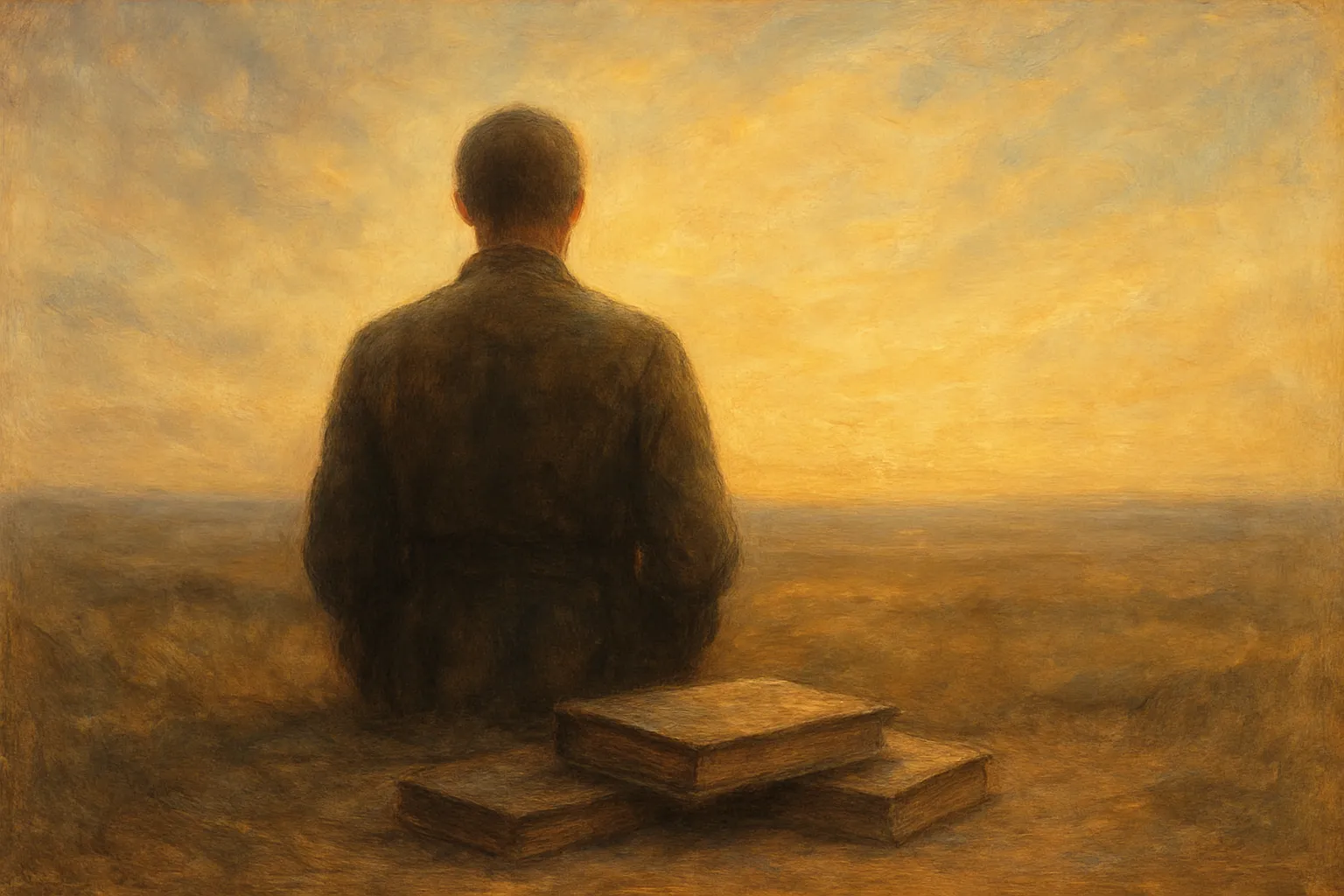
The greatest conflict is not behind you, but within the sheer, terrifying expanse of the ordinary world. This poem is an epic command issued by the seasoned Self to his younger, newly-civilian counterpart. It is a clarion call to abandon the rigid, hyper-controlled mechanisms of naval life—the constant monitoring of one's own cadence and the obsession with documentation—and to confront the immense, unmapped territory of freedom. The journey begins not on the sea, but in the absolute necessity of lifting the gaze from the self and embracing the chaos of the surface.
The Vigil of the Shore: An Epic Admonition
Don't look down.
There are horizons to capture beyond the cadence of your feet,
or the meagre script you write—this poem—
presenting the false, solitary sea
of a path you claim less traveled.
Don't look down.
Behold what is true—the wide, unmoored world.
See what needs to be seen,
the way it must be seen: by accepting the surface.
Don't look down.
Stop writing long enough to understand this truth:
Your current sense of must is not caused by the temporary
state of transition.
The depression, the angst, the ego, the id—
none of these are channels to wisdom or power.
Don't look down.
You have passed through fire. You are not dead yet.
Don't look down.
Forget the allegory of the barracks and the watch. Be aware of the now.
The projection you fear is only the mind's own shadow-play.
The damp atmosphere of this quiet enclosure,
the stale, nervous percolation of your breath—
it is not a ship's hold. The light behind you
is only the door you left open to the sun.
Don't look down.
Wake up. Pay attention to the human scale of the battle.
The teacher—the future unfolding—has a purpose.
Question, opinionate. Do not salute every passing voice.
Every second cannot and will not be captured by your meticulous records,
and that inability to control is your first, great permission.
There is more.
Don't look Down.
Stop reading the logbook of your war.
The past is not vast enough for the journey ahead.
Interpretation
This poem functions as a definitive command to deterritorialize the military-industrial complex that has encrusted the subject’s psyche, urging the shift from a paranoid, controlled "Body without Organs" (BwO) to a free, creative machine. The repeated injunction, "Don't look down," is the primary corrective, a demand to halt the flow of desire toward self-monitoring and internal narrative ("the cadence of your feet," "the meagre script you write"). The poem critiques the military's imposition of a "false, solitary sea," which is the fabricated, highly coded territory of the Navy; the transition to civilian life requires the acceptance of the "wide, unmoored world"—a new, chaotic, and necessary deterritorialization.
The core of the schizoanalysis lies in dismissing the internal flows of crisis as sources of authentic production. The states of "depression, the angst, the ego, the id" are explicitly denied as "channels to wisdom or power," meaning the flow of pathological desire is merely reactive, not constitutive of liberation. The older self demands the younger cease the neurotic production of the logbook of your war, recognizing that the obsession with meticulous records attempts to capture and therefore control the continuous flow of time.
The analysis pivots on the nature of the enclosure. The "damp atmosphere of this quiet enclosure" and the "percolation of your breath" represent the residual territorialization of the self—the lingering belief that existence must be confined and monitored like a ship’s hold. The "projection you fear" is the paranoid, self-referential machine of memory. The only escape is to confront the "light behind you," which is "only the door you left open to the sun." This simple, material reality—a door, an external light—is the ultimate anti-allegory, revealing that the prison is merely a self-maintained blockage in the flow of life. True "permission" (the ability to create new flows of desire) is found in the "inability to control," necessitating the failure of the military's rigid, controlling machine. The final command, "Don't look up," simultaneously rejects both the old, internal world and the false, transcendent narratives, demanding the subject stay grounded in the surface of the present world, which is "not vast enough" for the journey ahead—a necessary inversion that pushes the subject toward an unknown becoming.
Comments
Post a Comment