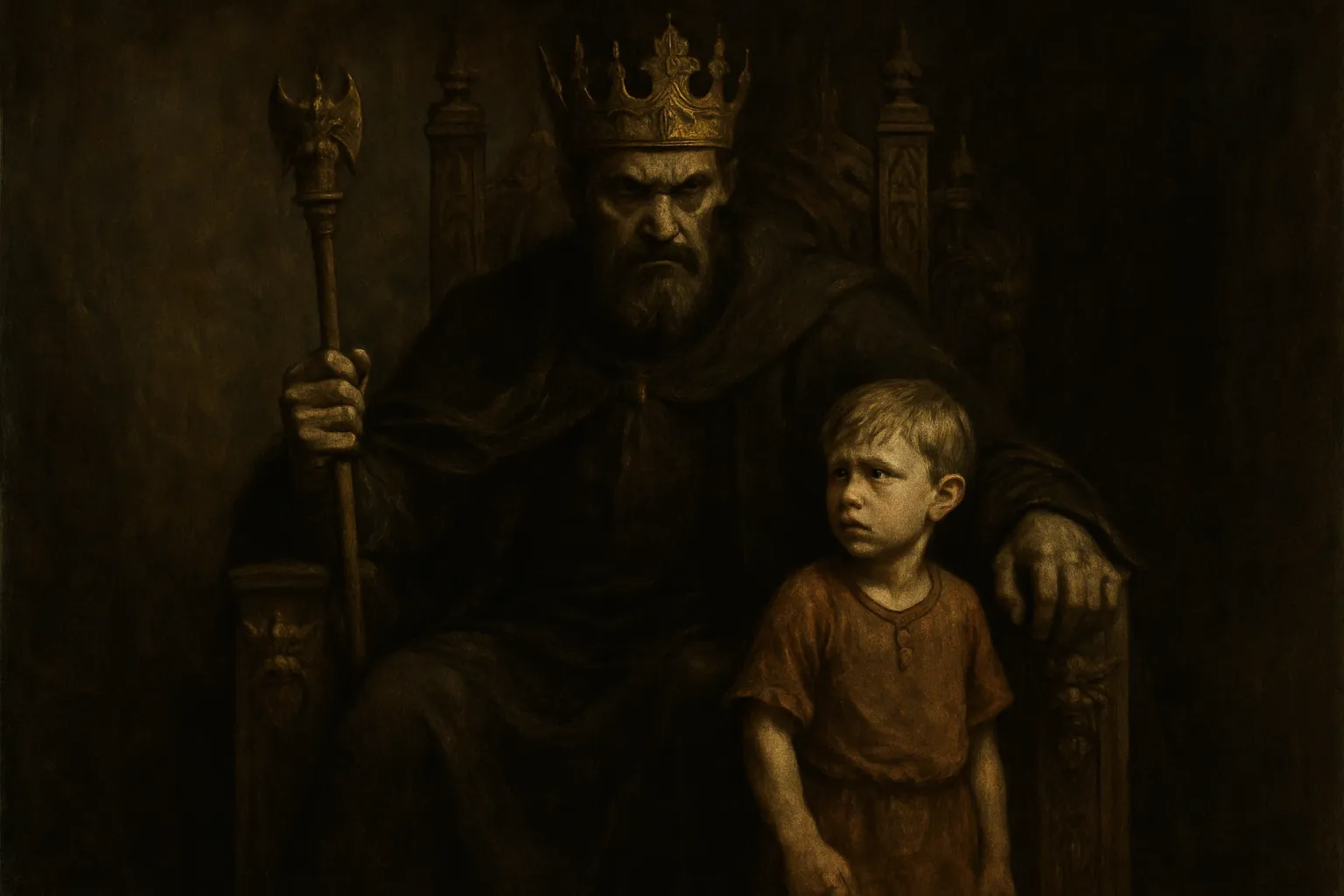
The world is a stage, but this chronicle is rendered in the cold, black ink of an auditor's grief. This obscure lamentation transforms the domestic sphere into a Jacobean tragedy, dissecting the violent, contradictory life of the Father. The monologue treats memory not as nostalgia, but as a forensic examination of generational abuse, where every object—from the blue truck to the unused paint set—is a sealed exhibit in the ledger of a dynasty built on madness and shame.
The Tyrant
My father, the factotum's shade, did pace a hundred leagues
For whim's scant favour, yet did cleanse his chin each sun,
Ere his blue tumbrel—that foul Ford—did snatch him from our gaze.
I watched, too slight to span the cistern's edge, a changeling mute,
Scrying the fixed, grim rubric of his stern egress.
My father, the subterranean artificer, did toil below,
Grinding the root's sweet heart, steeping vile aqua fortis
In cauldrons hot as Cocytus, whilst he did oft disgorge
A jest of rankest strain: how women's ample form
Was like the squirrel's dole, seized 'twixt the frantic paw.
Such base similitude did poison my soul's quintessence.
My father vanished, swallowed by the wide, salt gulfs,
To climes where speech was mute, for seasons of the year.
He brought no warrant back; his void the sole impost.
My father, by some black writ, was haled, one later noon,
Into the constable's black chariot. He gave no sign, no grace;
A sudden attainder, sealed without ceremony.
He fled the domus, quitting all his fragile claim:
A strange library of stellar apocrypha—the testament of feigned flight—
And socks of triple stain, severed by partition's art,
A limner's coffer, prized, yet ever virgin still;
The promise of creation, held in perpetual abeyance.
My father, the fleshly trespasser, did usurp his pucelle’s spring,
A tithe that could not be repaid in any coin.
He cast the calumny upon his spouse’s frigid bed,
For she had found his secret—his vile, solitary flux.
The marriage bed, now but a tomb for mutual guilt.
I durst not cast my speculum upon their malady.
He scourg'd God's sacred effigy from my pale frame with splintered wood.
I proffered up my wrist upon the shattered floor,
To earn his flinty gibe: "A poor essay; go mend thy craft."
Such was the brutal catechism of his cold, stern grace.
He lured me to the leap upon my grandam's tenter-bed,
A treacherous engine, where I brake my skull and fixed my pate
Betwixt the iron stanchion and the velvet's plush embrace.
I marked my mastic fall as the leech's needle pierced my crown.
The chirurgeon and my sire shared a loud cacchination!
My agony became their vulgar interludium.
I wept till all my passion was congealed by drought.
He sent me to the Fleet, with cheap, regal chirographs
For Burger King, and scrolls of Roswell's fantastick lie.
The sole hand-script lay upon the outer parchment's edge.
My father, the primogenitor of my woe, by his seed didst grant me lease.
I hold no memory of gait or tongue, save six harsh hours,
When, eight years since, I took an axe to a century-old tree.
He called it amity. I counted rings: the wound outlives the century's writ.
He raised a steaming dunghill behind the out-house, where rot
Did breathe a fume like dreams that vanish with the light.
The domus's leavings steeped in manufactured vapour.
He hid his shameful yard as I descended the stair's steep pitch,
Fumbling to banish his vile schema from the glass
That I, his very progeny, had wrought. My wit didst reveal his fleshy panic.
He sought penitents in the gaol, finding his new consort there.
She taught the scripture with silent tongue more aptly than with voice.
The prison walls did apotheosize their forbidden commerce.
He grew old and was exhaled. I, far o’er the seas, did wander,
Drunk in foreign alleys. My sister came, a thrall to complicity.
My mother joyed, for finally the clerk of terror ceased his script.
My father’s name, upon my uniform, is oft misread,
Taken for Hebrew kin. A lineage misunderstood, escaping its own heraldry.
His name is writ upon his urn. For Christ forgiveth all:
The defilers and the murderers, the sadists, and the self-hanged for vile cause.
Verily, God must have borne a greater flagellation than I,
To sanction such vast and fearful plenary indulgence.
He loved his blind brother. My grandam barred all access
Beyond the first chamber; the bedrooms were anathema.
The house did reek of grapes long turned to verjuice.
He spoke in unknown tongues, as if the Deity were stone,
Shaming himself in every consecrated aisle.
He bade me tie my own shoes, yet, at ten years old,
Did show me how to knot the hempen tribute with a mere wire.
The grim telos shown before the simple means of transit.
He slew himself with fire, meddling with the circuit's heart,
Just ere the house lights failed. A final, dark consummation of his woe.
Interpretation
The poem functions as a materialist critique of the Family Machine, treating the father and the home as agents of production whose primary outputs are trauma, debt, and the suppression of desire. The monologue is a record of flows and cuts, documenting the system's inherent failure to contain its own chaos. The Father is established as the "factotum's shade," a mobile, alienated unit of production whose ritual ("cleanse his chin each sun") is a constant, neurotic attempt to territorialize the uncontrollable flow of his desires. This pure, aimless movement ("one hundred leagues") is violently cut by the "blue tumbrel," the bureaucratic social machine, which demands the strict, rigid "rubric" of his daily egress. This conflict makes the Father a machine attempting to regulate two conflicting circuits: the psychotic flow of his libido (the "vile, solitary flux") and the neurotic structure of his patriarchal role.
The domus is transformed into a factory floor for shame. The Father, the "subterranean artificer," works with "aqua fortis" and "grinding the root's sweet heart," showing that the production of food is inseparable from the production of fear (the joke about scarcity). The ultimate output of this system is decay, evidenced by the "rotten grapes" and the "steaming dunghill"—the house produces verjuice, not sustenance. The violation of the "pucelle’s spring" and the technological exposure of his "shameful yard" by the computer the narrator built show how the child’s burgeoning autonomy constantly exposes and wounds the Father Machine’s protective, secretive shell. Furthermore, his flight into Star Trek "apocrypha" and the sending of Roswell "fantastick lie" pamphlets are archives of failed attempts to deterritorialize or escape the domestic prison.
The narrator views his body (the Body without Organs, or BwO) as a site of external violence and regulation, not freedom. The self-inflicted injuries (broken glass, the tenting-bed crash) are not just pain; they are "essays" and "interludiums" produced for the Father's "cacchination." The system's regulatory violence is clear in the final lessons: the Father prioritizes the skill of self-negation (the hempen tribute) over the skill of social mobility (tying shoes). Finally, the Father Machine’s production is revealed to be fatally flawed. The name on the uniform ("A lineage misunderstood, escaping its own heraldry") is a signifier that fails, proving the Father's output is contaminated. The final electrocution, where he kills himself "meddling with the circuit's heart," is the machine’s ultimate auto-critique—a self-terminating circuit that consumes the maintenance worker when the structural failure becomes total.
Comments
Post a Comment