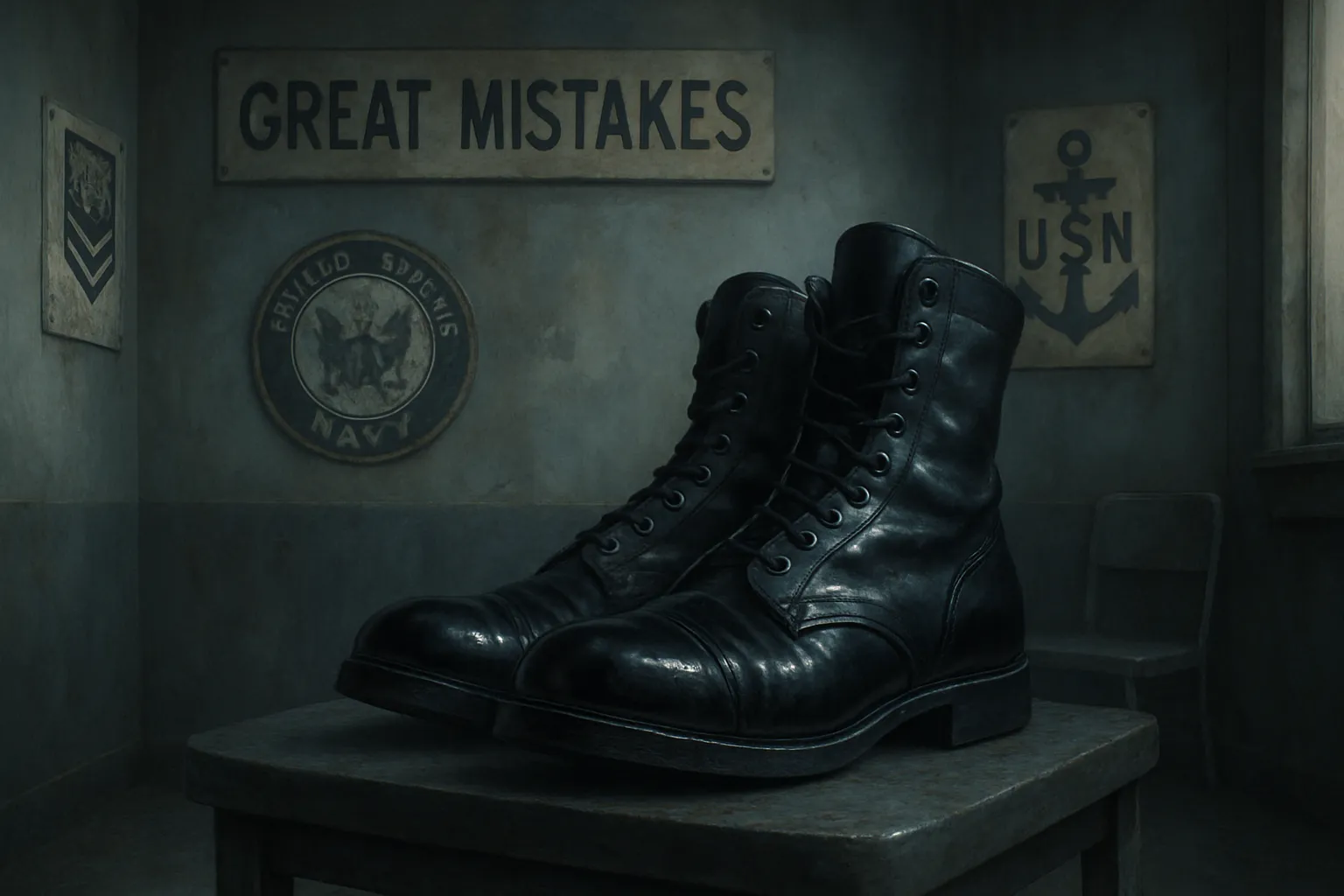
Behold the detonation of consciousness at dawn. This document is a record of psychic endurance against the absurd repetition of military bureaucracy. It charts the narrator's prolonged purgatory in naval bootcamp's holding status, where physical failure was met with an endless, cyclical demand: "run." The narrative escalates from the silent trauma of standing at attention to the ultimate, ironic truth: that the system rejected the speaker based on metrics of land (running), even though their true competence—in water—was flawlessly proven, permanently isolating the body from the social world it sought to rejoin.
The Litany
I. The Static of Attention
I stood in the office at rigid attention,
a vertical corpse against the bulkhead.
Sweat crawled down my nose, thick and saline.
My shirt, meticulously buttoned, hung saturated,
the damp heat clinging to my midsection.
I was singing vibrations—not sound, but internal frequency,
a thousand desperate little monks chanting to the ether,
ripping holes in the membrane of the universe.
And I stood at attention, weeping.
The Chief told me to close the door—a private execution.
He questioned me, and his voice shifted,
cracked open with a sudden, unwanted current of sympathy,
a flow I hadn't heard in this machine before.
"I don't want to be here anymore," I managed.
II. The Calculus of Endurance
He scratched the scarred underside of his chin.
His wisdom was a single, cruel, perfect word:
"All you have to do is run."
Run.
Every week, a relentless, cyclical baptism of failure.
The asphalt blurring, the lungs burning out of my chest,
re-failing until the body became a pure number,
a necessary submission to the system's will.
III. The Ritual of Maintenance
We were the excess, the backlog, the inventory on hold.
With no cycle to run, we were given all the free time
that the machine couldn't account for. So we scrubbed.
We cleaned the running facilities, polishing the very surface
that demanded our exhaustion. We swept the cinder
from the hurdles, sanitizing the instruments of the cycle,
folding the unused time back into the architecture of maintenance.
IV. The Vanishing Territory and The Permanent Cut
Years later, I returned to Great Mistakes Naval Station.
I found nothing. They had leveled it all—
every barracks, every gray building I remembered,
all the walls that had framed my despair, gone.
The architecture of my suffering was scraped clean.
I took photos of a small sailor gnome, misplaced,
a porcelain marker where memory used to stand.
The whole base was a blank slate.
The cycle of running and maintenance,
had consumed the raw material of my social wiring.
I demanded the final judgment: The Captain's Mast.
I, the failure of the land-based physical test,
passed the swim test on the first try—a clean, silent skill.
My competence belonged entirely to the water,
the one thing the Navy required,
yet I was rejected by the system's simple, terrestrial math.
I left the machine, carrying the silence of those scrubbed tracks,
permanently isolated from the frequencies of the civilian world.
Interpretation
The initial moment in the Chief's office is a classic manifestation of the Freeze response. Standing at "rigid attention," the narrator’s conscious physical control is absolute, but the internal system is overwhelmed, leading to involuntary emotional flooding ("weeping"). This dual state—trapped between the external demand for stillness and the internal Vagal System registering overwhelming threat—is a defining characteristic of trauma, where the natural fight or flight response cannot complete itself. The narrator's attempt to cope through "singing vibrations" and "ripping holes in the membrane of the universe" is a clear sign of dissociative coping, seeking to escape the intolerable present by creating an internal, alternate reality.
The Ritual of Endurance, the "Litany of Thirty-Six Fridays," serves as a massive trauma reenactment cycle. Repetitive, cyclical failure, particularly under an authority figure's arbitrary decree ("All you have to do is run"), locks the body into a state of learned helplessness. The subsequent "Ritual of Maintenance"—cleaning the very facility that consumed them—is a paradoxical use of "free time" that ensures the perpetual engagement of the trauma. By forcing the narrator to focus their effort on sanitizing the instruments of their own humiliation, the machine prevents any psychological space for processing or recovery, solidifying the lost time as trauma time—a continuous, non-chronological state of arrested development and psychological exhaustion.
The forced "free time" spent on maintenance ("folding the unused time back into the architecture of maintenance") signifies identity arrest. The narrator is placed outside the flow of normative time (the bootcamp cycle), leaving a psychological void. The thirty-six Fridays are not chronological time, but trauma time—a continuous present that destroys the capacity for autobiographical memory and future projection.
The final scene, where the base is "leveled," symbolizes the invalidation of memory. The architecture of suffering is erased, confirming the institutional lack of accountability and denying the narrator's trauma a physical resting place. The misplaced sailor gnome becomes a pathetic, externalized self-object—the only concrete marker of the abandoned self.
The ultimate consequence is a defect in relational capacity. The repeated isolation and the breakdown of normal communication (the Chief's voice being a "flow I hadn't heard in this machine before") permanently calcify the narrator's social wiring. The concluding irony—passing the swim test—is a final metaphor for this isolation: competence restricted to an isolated medium (water), confirming an inability to function on the "land" of human interaction. The narrator leaves the military but carries its "silence" and "scrambled frequencies," making genuine connection impossible.
Comments
Post a Comment