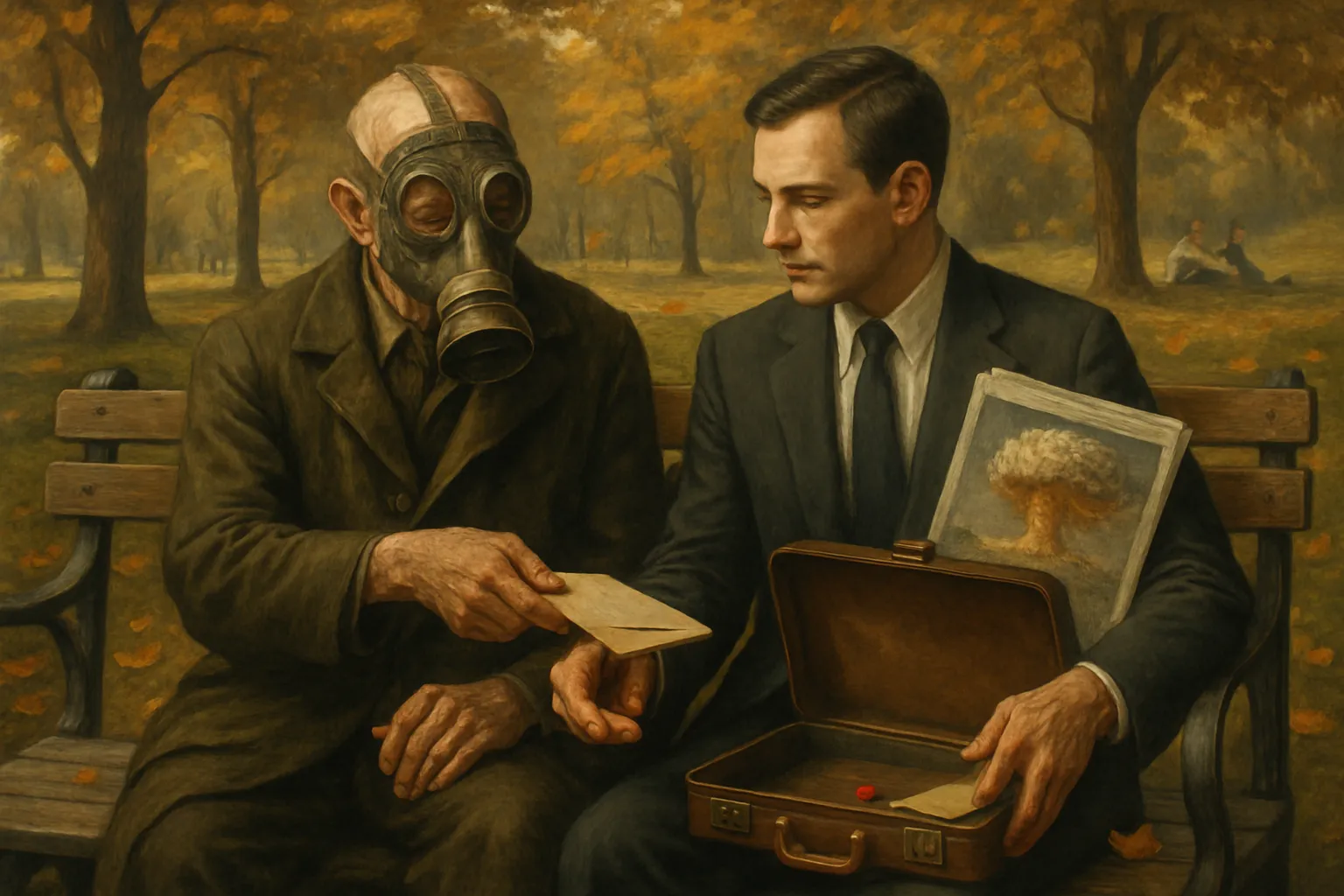
This poem establishes a chilling, hyper-capitalist future where the instruments of absolute destruction are consumer goods advertised alongside daily news. The protagonist operates within a completely deterritorialized society where war, eugenics, and annihilation are normalized as transactional commodities. The narrative focuses on a clandestine exchange—a nuclear hand-off disguised as a mundane park meeting—where the ultimate power (the bomb timer) is treated with the same cold indifference as adjusting a tie or reading a newspaper advertisement. The piece culminates in the ultimate act of aestheticized violence, confirming that in this system, desire and destruction are seamlessly fused into a single market flow.
Nuclear
Nuclear.
The envelope was folded
and slipped between the classified
section of the Saturday paper.
The front page ad—
a full-color spread of what your town
would look like after an atomic
blast.
Seven payments of
199.95!!!
Order now and receive,
at no additional cost,
a fully armed U.S. Army bazooka.
And if that doesn’t
catch your fancy…
You stopped reading
and adjusted your tie.
You looked down
at your brown suede shoes.
You waited.
You held the paper
tight beneath your arm.
You felt the bulge
of the hidden envelope.
You saw him—
old and wrinkled, sitting on a park bench.
A brown briefcase rested across his lap.
His skin sagged; deep shadowed trenches
ran across his brow.
He didn’t look up,
but you felt he knew you were near.
You walked the path
beneath the canopy of fall trees.
The edges of the trail
were littered orange and brown.
He wore an antique gas mask—
dark green—
the kind the government handed out
after the Population Control Act was passed.
Leftovers from the last great war.
You sat beside the old man
and began reading the paper.
The envelope slipped.
You skimmed an article
on current ethnic cleansing
and its effect on the breeding farms.
The old man set his brown briefcase
on the bench between you.
He bent, tied his shoes,
and swept the envelope
into his pant leg.
The old man looked at you,
winked,
and disappeared
down the leaf-cluttered path.
You placed the briefcase on your lap,
flipped the clasps,
and opened it.
The timer was set.
You pressed the red button
and watched a couple
cuddle in the grass
disintegrate.
EInterpretation
The entire narrative functions as a terrifying Desiring-Machine where the capitalist market and the machine of war have fully merged, leading to a state of Hyper-Deterritorialization where no moral or social codes remain relevant.
The Market-Flow of Destruction: The front-page advertisement is the ultimate articulation of the Anti-Oedipus concept: desire is not based on lack, but on production. The atomic blast is produced, sold on an installment plan, and bundled with a "fully armed u.s. army bazooka." This Commodity-Weapon Flow normalizes genocide (the article on "ethnic cleansing and its effect on the breeding farms") alongside weekend sales, creating a world where all flows—capital, death, sex, and news—run indifferent to human consequence.
The Agents of the Machine: The two main characters are merely interchangeable Flow Regulators. The narrator is highly coded ("adjusted your tie," "brown suede shoes"), representing the perfectly integrated social body (the Socius) whose function is to maintain the smooth exchange of power. The old man, described with sagged skin and deep trenches, represents the Archival Body, the decaying repository of past wars and regulations ("population control act"). His antique gas mask signifies the continuation of the War Machine through history, wearing the leftovers of past trauma as functional attire.
The Schizophrenic Exchange: The physical exchange is profoundly detached. The briefcase (the machine) is traded for the envelope (the financial code/order) in a silent, ritualistic dance (tying shoes, sweeping the envelope). The old man disappears—a pure Line of Flight—leaving the narrator to enact the final coded gesture.
The Consumptive Climax and BwO: The moment the narrator receives the briefcase, they assume the absolute power of the Death-Machine. The action of pressing the red button is the ultimate Cut, immediately reducing the cuddling couple—representing simple, organic life-flows—to pure disintegration. This final act is an aesthetic consumption: the narrator watches the couple vaporize, transforming organic reality into a fleeting visual effect. The act enforces the Body Without Organs (BwO) principle on the world; the couple’s organic unity is instantly dismantled into dispersed energy flows, confirming that the ultimate power in this market-war system is the ability to instantly deterritorialize life itself.
Comments
Post a Comment