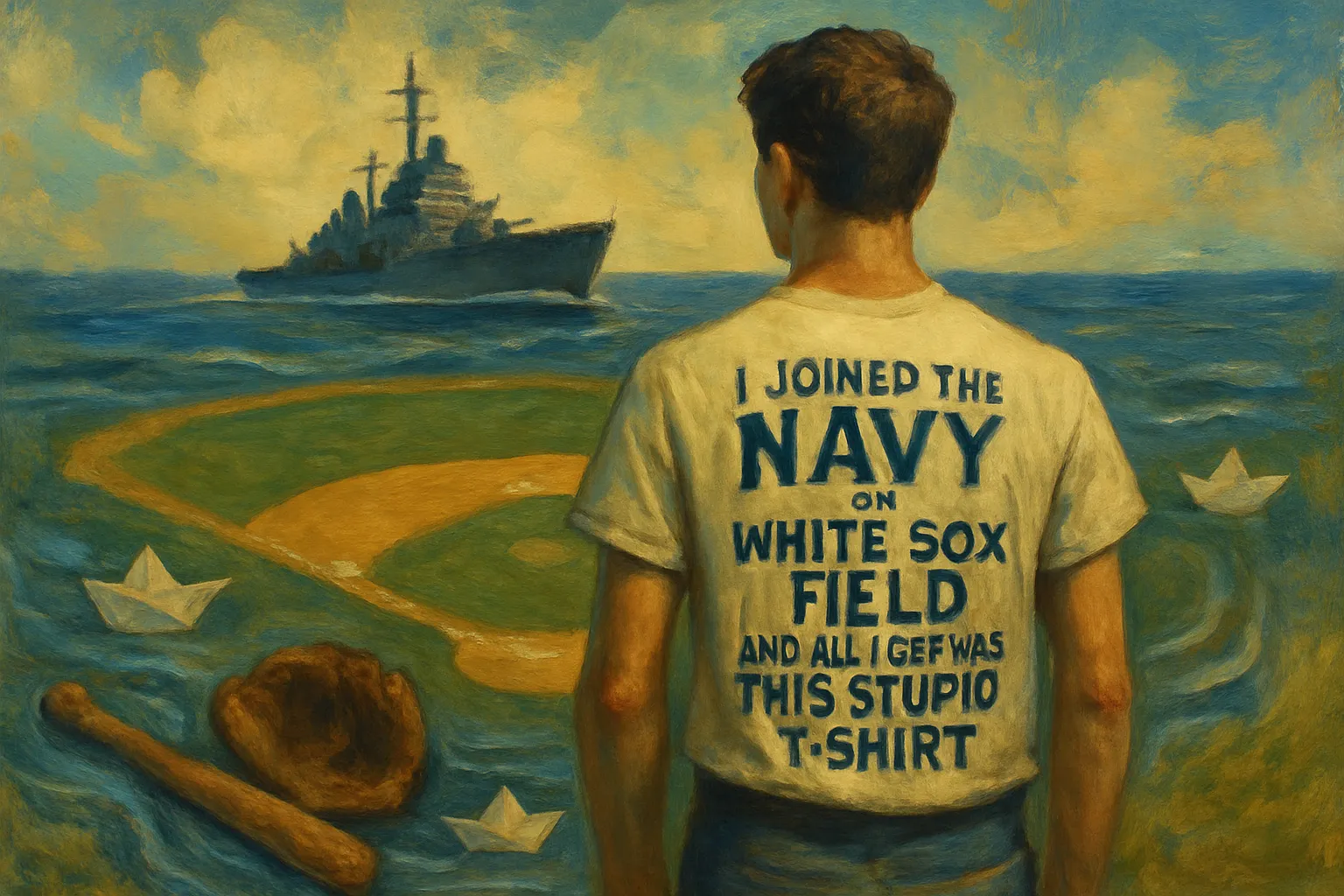
The noise was cheap static, but the price was absolute. This poem captures the precise moment the military machine claims its property, using a major league baseball game—the ultimate symbol of American civilian complacency and summer leisure—as its hunting ground. It is a cynical chronicle of illusion giving way to brutal, instantaneous reality, charting the transition from the desperate assertion of flesh in a bathroom stall to the cold, structured discipline of a white bus, all set to the soundtrack of adolescent anxiety.
The Seventh Inning: Hostage Exchange
I remember the first hour of the setup.
It began at a baseball game,
South Side, on U.S. Cellular Field.
The White Sox were doing their ritual.
We weren't watching. The noise was cheap static.
Maddox, oblivious, was screwing his girl in the third stall.
A desperate, final assertion of the flesh.
Jensen, smiling, chatted up his mother,
the family tableau perfect: proud ignorance.
They didn’t know the trade-off. And neither did we.
I was staring at the half-eaten pizza. Heavy, cold, civilian rot.
My stomach was already sick from the lie.
We all wore the same pathetic uniform of the uncommitted:
The White Sox Special Recruit Division U.S. Navy T-shirt.
The White Sox offered us novelty shirts,
and free tickets to a ball game,
a final kindness,
but only until the fifth inning. Always a hard limit.
We were half-way through the seventh-inning stretch—that disgusting,
manufactured joy—when the screaming hit, right there in the stands.
Boot camp started before the game ended. We were instantly herded,
taken hostage by the Drill Instructors. The crowd cheered,
oblivious to the seizure happening in the upper deck.
Then, the world contracted to the cold interior of a white bus,
speeding us north toward Great Lakes Naval Station.
Green Day was playing "Basket Case" on the radio.
I couldn't look away from the Southern woman driving,
mesmerized by the low, slow, unfamiliar sound of her accent,
and the sudden, stupid weight of a crush.
Interpretation
The narrative functions as a critique of the symbiotic relationship between the Civilian Social Machine and the Military Machine, documenting the complete, violent deterritorialization of the subject’s body and desire. The setting—U.S. Cellular Field—is the final, soft territory of the status quo, saturated with "cheap static" and "fat with privilege." The Navy utilizes a public spectacle (the baseball game) as a camouflage for its seizure of fresh bodies. This is the socius performing its function: feeding its young into the war machine under the guise of patriotic novelty and free entertainment.
The initial flows of desire and life are brutally contrasted with the imposed limit. Maddox's "desperate, final assertion of the flesh" is the last, frantic flow of pure libidinal desire before the military's rigid code cuts in. Jensen's family tableau represents the flow of "proud ignorance," the flow of the civilian machine's self-deception that the military is merely an honorable job, not a totalizing capture. The T-shirt—the "pathetic uniform of the uncommitted"—is the temporary, low-grade coding necessary for the exchange. The ultimate limit is fixed and absolute: "only until the fifth inning."
The moment the screaming begins marks the successful territorialization of the body by the military machine. The recruits are instantly "herded," becoming "hostage," illustrating the instant conversion of civilian freedom into military property. The crowd's oblivious cheering confirms the civilian world's necessary schizophrenic denial of the violence being enacted in its presence. The final paragraph details the forced flow into the military structure, symbolized by the "cold interior of a white bus" speeding toward the institutional territory of Great Lakes. The driver, the Southern woman, represents the exotic, unfamiliar, yet functional face of the new machine. The crush is the subject's final, desperate attempt to reterritorialize a spontaneous flow of desire onto a human figure ("mesmerized") just as the military machine forces him into complete submission, all while the soundtrack, Green Day's "Basket Case," ironically underscores the precise neurotic breakdown required for entry into the new, disciplined flow.
Comments
Post a Comment