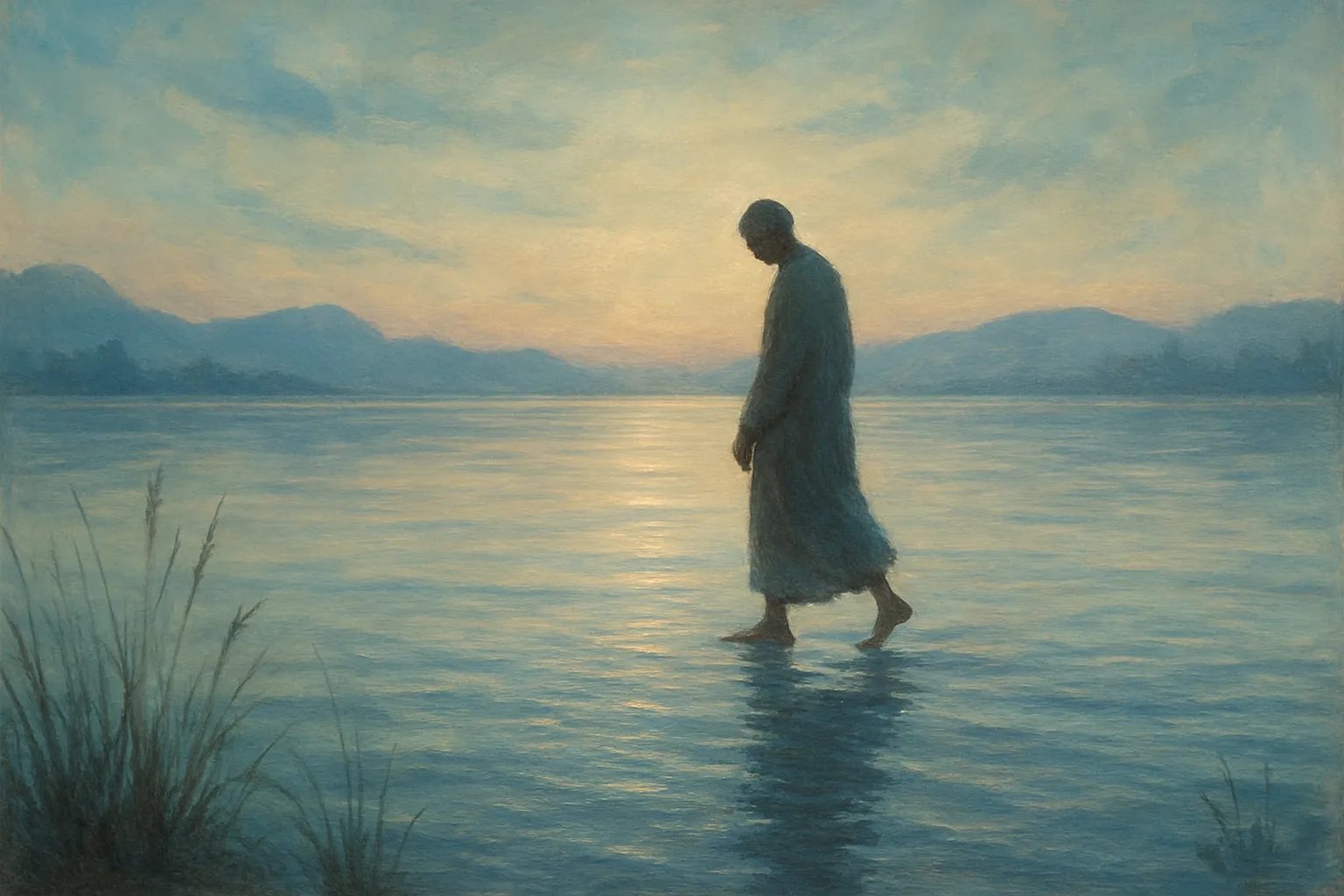
What happens when physics breaks down under the weight of sheer will? This poem is a volatile philosophical rant, a series of non-sequiturs that defy religious dogma and scientific law through a single, impossible act: walking on water. The speaker treats this miracle not as a demonstration of faith, but as a psychic breakdown—a forced rejection of gravity dictated by a mind pushed past its breaking point. It is a fragmented, dark meditation where the divine, the physical, and the traumatic merge into a single, terrifying equation.
The Surface
I walked on water to prove a theory,
yet the audience was absent.
Smiling is not a symptom of happiness,
but the grimace of a god who forged a world
beyond his own calculation, now uncontrolled.
I walked on water because gravity
is a latent segment of the mind,
a fragile discipline that collapses under pressure.
Mass distorts volume—the truth is relative—
lest memory should fail its own archive.
I walked on water because the Christ narrative
is etched in finality, written in death.
Water segregates skin tones, distinct and terrible,
like the unnatural fusion of gasoline and kitty litter.
I walked on water because simple minds
are created ex nihilo through the blunt trauma of childbirth.
I walked on water to find the sink point,
to plummet. Deep down, where there is no context
for light or the absence of it—
it is a forced immersion, a dream entered
at the precise threat of the blade.
I walked on water because the ocean
is a salty furnace where the children of the unloved
snort the ashes of their forgotten kindred.
Interpretation
The narrative is a manifesto of radical deterritorialization, using the act of walking on water as the literal rejection of the physical codes (gravity, reality) enforced by the social and philosophical socius. The subject's mind functions as a Desiring-Machine that overrides the universal flow of physics. The act is not spiritual but psychic—a collapse of the mental control segment that usually maintains the physical code ("gravity is a latent segment of the mind, / a fragile discipline that collapses under pressure"). This breakdown allows the subject to establish a temporary, schizophrenic Body without Organs (BwO) where logic and mass are redefined.
The rejection extends immediately to the religious and social coding used to justify control. The speaker redefines the divine grimace: God, like the subject, is a failed machine, having created a system "beyond his own calculation, now uncontrolled." The Christ narrative is instantly stripped of its miraculous flow and re-coded as a pure flow of finality ("written in death"). This allows the subject to reject all moral territorialization. The poem finds true terror not in the physical feat but in the social reality it exposes: water, the medium of the miracle, is immediately juxtaposed with social violence ("segregates skin tones"), demonstrating that the physical world is already deeply coded by hate, an "unnatural fusion" that the mind must reject.
The final movement documents the subject's desire for ultimate sink point—a complete, total collapse into the un-coded depths of the BwO. The desire is to plummet beyond the binary flows of perception ("no context / for light or the absence of it"). The trauma of being forced into consciousness ("simple minds / are created ex nihilo through the blunt trauma of childbirth") is mirrored by the final desired state: a "forced immersion, a dream entered / at the precise threat of the blade." This is the ultimate cynical vision of the origin of life and its end. The ocean is not a beginning but a final, destructive process—a "salty furnace" where new generations ("children of the unloved") are consuming the residue ("snort the ashes") of the failed, forgotten flows of the past. The walk on water is thus a temporary escape route designed only to find the fastest way to the terminal flow of annihilation.
Comments
Post a Comment