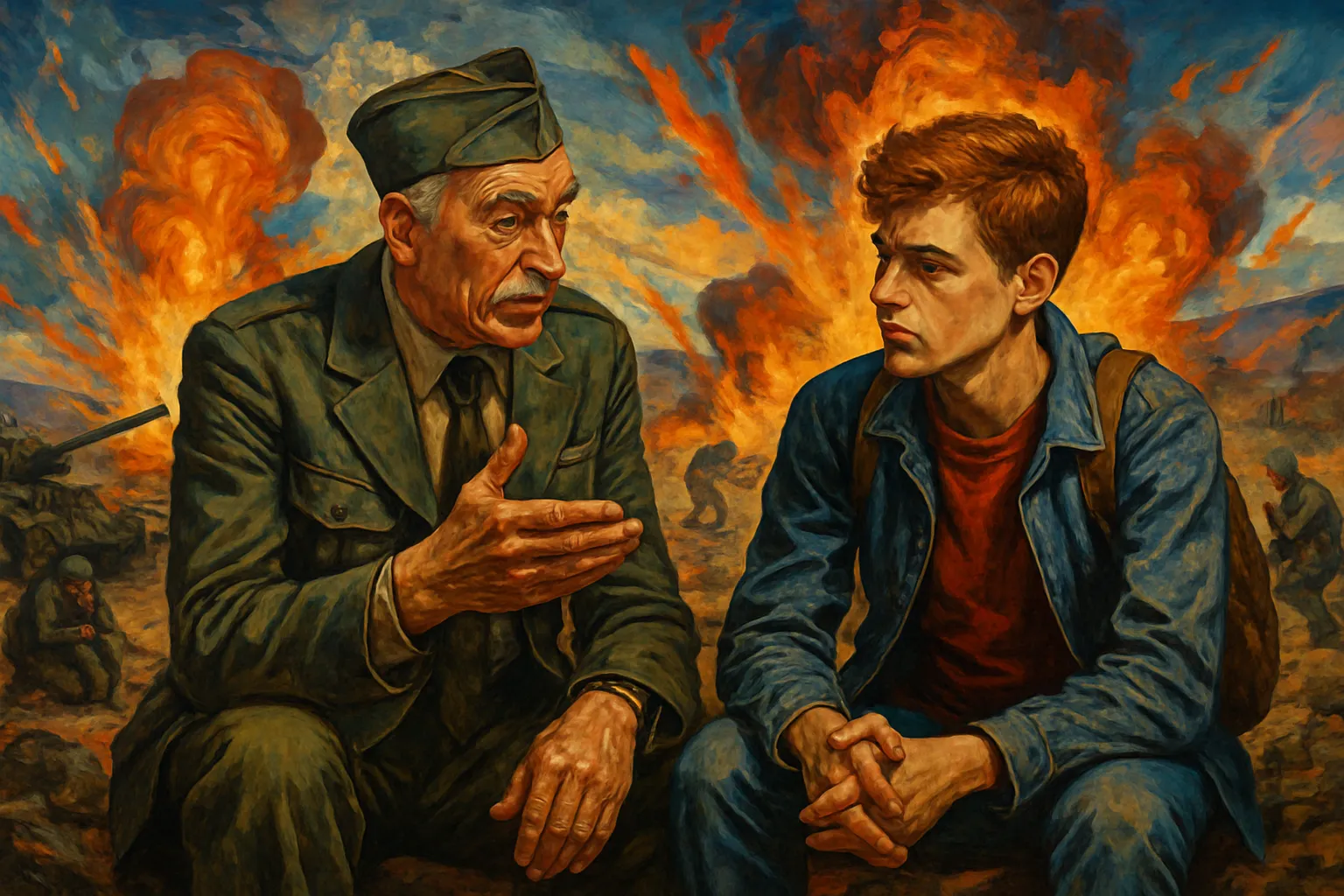
Don't mistake the world for a poem, kid. The world is a battlefield, and sentimentality is a weakness that gets you killed. The advice cuts through teenage melodrama, reframing every failure as a lesson in courage, and the practical demands of genuine human engagement over artistic pretense.
Shrapnel
You’re still talking about that paper bag. The clock hand keeps spinning—that's life, kid. Stop looking at the dial. You dwell on her hand, her hand on your shoulder. She never knew what that warmth cost you. You thought her kindness was a cure. I told you, you confuse things. You called it stopping the gangrene, so you sat down and wrote a poem.
You wasted days. Days. Trying to find the perfect word. Metaphors bursting? I've heard the real noise, son. Don't tell me about bursting. You finally worked up the grit to deliver it. Wrote it on a paper bag. You thought that made it special, didn't you? She laughed. She asked what in God's name you meant. Listen to that.
You think your mind shattered? It didn't. You threw a brick through a garage window at age nine and ran. You never saw anyone, but you ran. That wasn't courage, that was just reflex. You ran away from the fallout.
You were in love with the idea of her, and your poem was prettier than she could ever be. You loved the paper, not the girl. Her eyes went blank. Those customized words you prepared— they went nowhere. A clean miss. Waste of ammunition.
And you know she wasn’t trying to be cruel. When she told you, “You never knew you felt that way,” She gave you a blueprint, and you chose to see shrapnel. You always look for the wound. Get off the floor. Get a backbone. Clarity is a weapon. Next time, ask her to a picture show. Do something real.
Interpretation
The poem is entirely recast as a direct, pragmatic monologue from the World War II grandfather, stripping the grandson's experience of its adolescent emotional drama and framing it through the lens of wartime necessity and survival.
The grandfather's worldview is immediately imposed: the spinning "red hand" is not a symbol of fate, but a command to "stop looking at the dial"—a rejection of passive dwelling. He corrects the grandson's internal narrative, stating, "You thought her kindness was a cure," dismissing the romantic belief that the girl's casual warmth offered salvation. The core lesson is that genuine healing is active, not passive.
The contrast between the grandson's "perfection" and the grandfather's reality is stark. The metaphors "bursting" are noise, not trauma: "I've heard the real noise, son." The veteran's experience diminishes the art to juvenile noise. The "paper bag" is a failure of presentation.
The key moment of emotional breakdown is reframed as a lesson in failed courage. The trauma of throwing the brick and running is analyzed clinically: "that wasn't courage, that was just reflex." The grandfather demands intent and ownership. The ultimate failure in the poem is revealed when the words ricochet because the grandson was in love with his own creation, not the girl herself. The climax, where the girl denies knowing his feelings, is interpreted as a gift of clarity rather than cruelty: "She gave you a blueprint, and you chose to see shrapnel." The final advice advocates for simple, direct action ("Next time, ask her to a picture show. Do something real.") over confusing, protective emotional performance.
Comments
Post a Comment