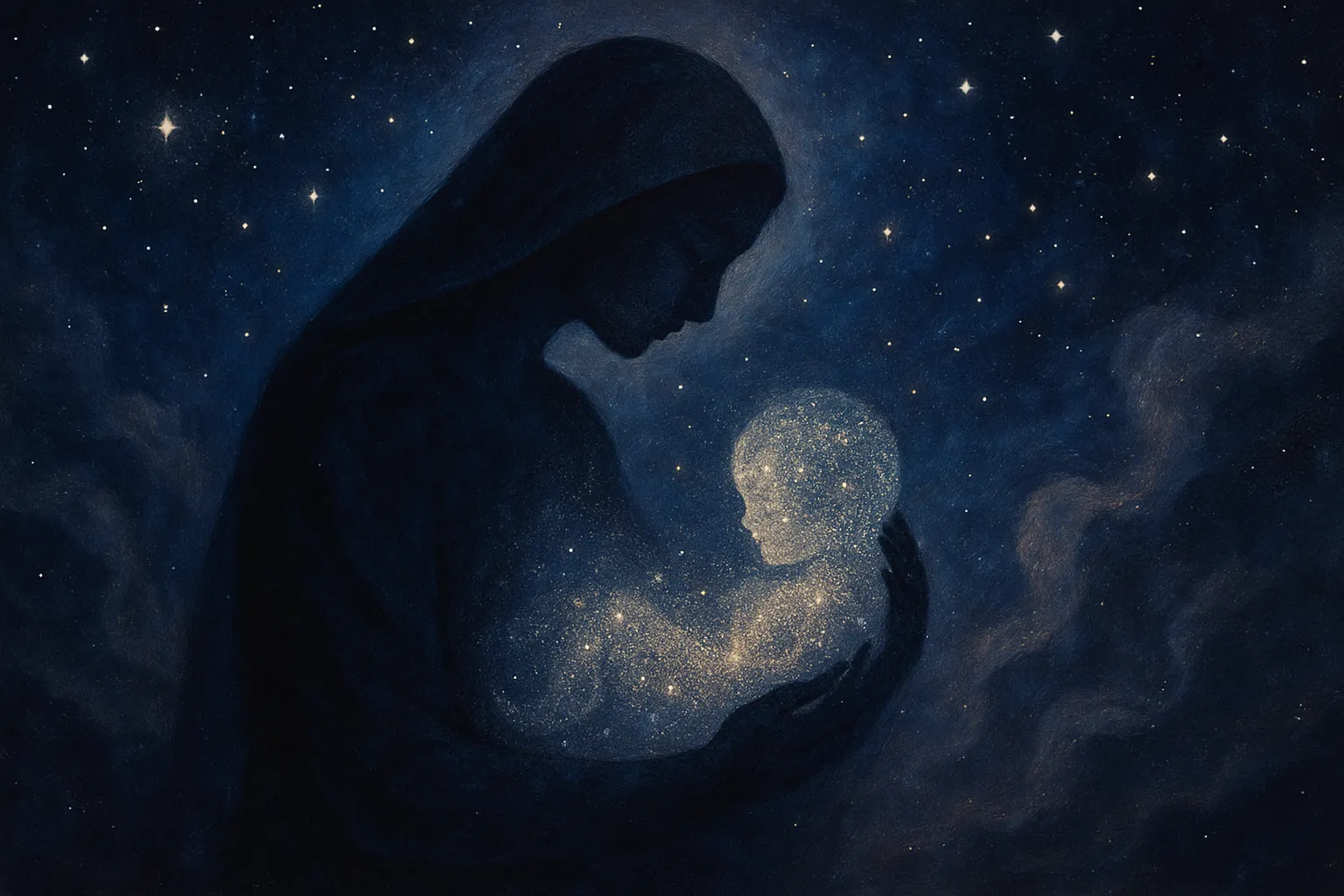
Listen for the sound of silence—the thunder of unbeing. This poem descends into the fetal darkness, giving voice to a potential life violently excised not by external force, but by the cold, sovereign will of the host. Adopting a tone of mythological grievance and sensory overload characteristic of Plath, the speaker confronts the incomprehensible act of self-erasure. It is a terrifying epic of molecular betrayal, where the promise of a universe is negated by a "shutter of light," leaving behind only the profound confusion of a consciousness that existed solely to be unmade.
The Unmade Star
Part 1 : The Wreckage of the Womb
Confused aborting smiles,
a distant, watery glee.
I was not at the clinic.
No steel, no sterile gleam for my unmaking.
She took it upon herself,
a sovereign will, a god in miniature,
to disappear me.
Not a whisper of my name in waiting,
no future tense of breath or bone,
just the cold, finality of her own decree.
A silent, inward thunder. Boom.
No more baby in her gut.
No more flicker, no more nascent current.
A sudden, voided space where galaxies had spun.
What am I supposed to say, a cosmic dust,
dispersed, before the dawn?
Part 2 : The Grand Betrayal of Flesh
I was a blueprint, a grand, imagined architecture,
the intricate calligraphy of blood and nerve,
a nascent sun within that private ocean.
I felt the tides, the whispers of her hunger,
the soft, dark rhythm of her sleeping dreams.
And then the shift, a subtle, cold withdrawal,
the tightening vise of her deliberate will.
The great betrayal, not of blade or drug,
but of an inner alchemy, a turning-off, a shuttered light.
My burgeoning universe contracted, snuffed.
The great bell tolled for naught.
To be unmade by such intimate decision,
to have my very genesis undone from within—
a profounder wound than any scalpel’s edge.
Part 3 : The Echo of the Unlived
What am I now? A memory of a shadow?
A hypothesis unproven? A poem unpenned?
I was the promise of a future,
the answer to some unspoken question in the dark,
a tiny, furious heart that longed to beat
against the world's indifference.
Now, only silence.
A deep, abyssal calm where laughter might have bloomed,
or bitter tears, or the raw, untamed hunger of a human life.
I am the echo of a thunder never heard,
the ghost of joy, the phantom of despair,
a star that flared unseen, then winked to naught.
What am I supposed to say,
when my very tongue was swallowed
by the void she carved?
I am the unmade star.
Interpretation
The Mother's will functions as a final, absolute cutting plane; her decision is described not as a medical procedure but as an act of pure power—a "god in miniature" executing a "cold, finality of her own decree." This "turning-off" is the ultimate cut against the flow of life and desire that was spontaneously organizing within the womb. The subject (the fetus) views itself in highly abstract, cosmic terms ("galaxies had spun," "cosmic dust," "nascent sun"), emphasizing the infinite potential flow that has been reduced to zero, clearly illustrating the collapse of the BwO's production.
As the central conflict unfolds, the verses fixate on the violence of intimate encoding, where the promise of connexion is brutally betrayed. The fetus perceived itself as "a blueprint, a grand, imagined architecture," existing in perceived harmony with the maternal machine ("felt the tides, the whispers of her hunger"). The betrayal is the internal shift—an "inner alchemy, a turning-off"—which instantly reveals the womb was never a safe territory but a volatile factory governed entirely by the Mother's schizophrenic desire. The profound violence is immanent, occurring "from within" rather than via external instruments ("not of blade or drug"). The desire for life ("furious heart that longed to beat") is met with the BwO's power of abolition, a "shutter of light" that instantly converts potential into nothingness, documenting the maternal BwO's power to refuse production entirely.
The final section shifts to the desolate cataloging of non-existence, where the flows of language and potential are reduced to mere phantom effects. The fetus is left as a failed signifier, an unproven concept: "A memory of a shadow? A hypothesis unproven? A poem unpenned?" It is now defined solely by what it could have been, becoming "the echo of a thunder never heard." The core frustration is the impossibility of speaking or writing the trauma; the very "tongue was swallowed by the void she carved within." The chilling final identity—"the unmade star, the poem of the void"—is a self-designation that acknowledges the subject exists only as a linguistic artifact of its own erasure, a zero-degree example of a machine whose only output is the documentation of its total failure to begin.
Comments
Post a Comment