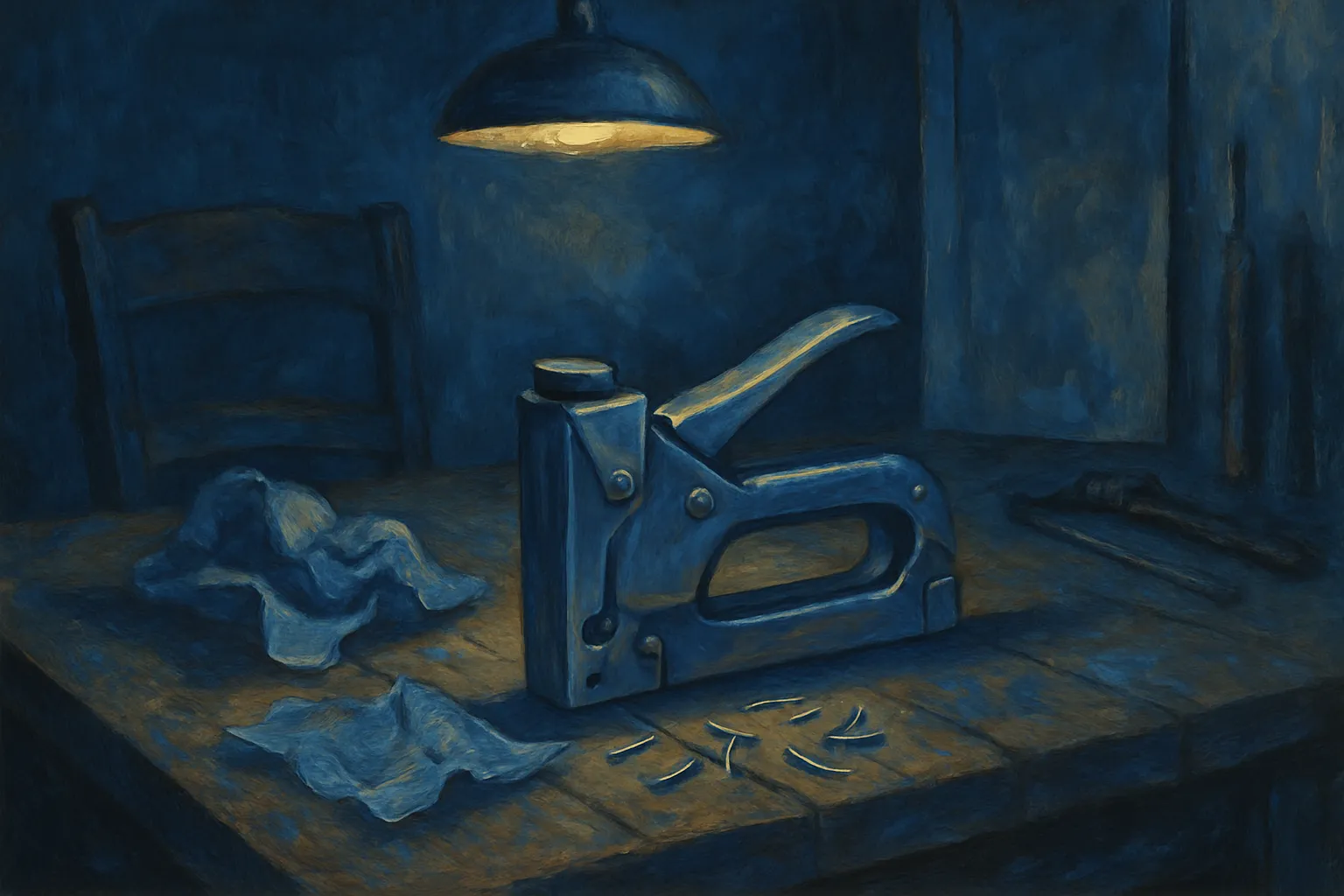
In the stark, brutalist landscape of this short piece, the self is rendered as an object, a piece of meat mounted for purely aesthetic or arbitrary reasons. We are faced with the chilling realization that existence precedes essence only to condemn the subject to a painful, meaningless facticity. This text fuses the raw, confessional violence of punk rock with the dense, cold weight of existential philosophy, presenting the ultimate confrontation: the absolute freedom of the individual expressed as absolute, immovable confinement. The suffering is not redemptive; it is merely proof of a futile, unchosen life.
Staple Gun Blues
Nailed to the wall.
Facticity established.
I am not just on the wall;
I am of the wall.
The nail is the ultimate Other,
driving the sheer, cold truth
of my non-choice into the sheetrock.
I can’t believe it’s not Jesus.
Because the structure of my being
is this agonizing, meaningless project.
This is not sacrifice.
This is not salvation.
This is confinement.
My skin stretches, the fiber rips,
and the only thing flowing out
is the absurdity of my existence
in relation to the dry rot and the cheap paint.
There is no exit. There is only the grip
of the wood grain.
This is freedom.
(And it tastes like rust.)
Interpretation
This text is a core assertion of Sartrean existentialism filtered through the minimalist violence of Rollins' spoken word, where the only certainty is anguish and the objectification of the self.
The opening lines—"Nailed to the wall. / Facticity established."—immediately define the subject's condition. Facticity (Rollins' "I am here, and it hurts") is the brute, unchangeable reality of one's existence, symbolized by the nail and the wall. The subject's current state is not a choice, but a circumstance, an external imposition. The realization, "I am not just on the wall; / I am of the wall," signifies the radical loss of distinction between self and environment; the subject is completely absorbed into the indifferent, confining territory of the physical world. The nail, serving as the "ultimate Other," is the instrument of this objectification, violently defining the subject's essence through physical constraint.
The central theological rejection, "I can’t believe it’s not Jesus," moves beyond simple atheism. It rejects the Christian promise of redemption or pre-ordained essence. The nail, which in a Christian context signifies sacrifice, here signifies meaningless "confinement." The subject's life structure is defined as a "meaningless project," a core Sartrean concept where the individual is fundamentally responsible for defining their life (the project), but finds the physical reality of that life devoid of inherent purpose. The pain is not a step toward salvation, but simply "the absurdity of my existence." The suffering is gratuitous, serving no transcendent master.
The poem concludes by fusing confinement with the concept of absolute freedom. The realization that "There is no exit. There is only the grip / of the wood grain" confirms the subject's physical imprisonment. However, the final, contradictory declaration, "This is freedom," is the ultimate existential jolt. Freedom, for Sartre, is the crushing responsibility of being forced to choose, even when the choice is only how one reacts to being nailed to a wall. The subject is condemned to this choice. The taste of "rust" serves as the final, brutal sensory detail of this realization: the anguish of freedom is metallic, visceral, and toxic. The self is an object, defined by pain, but eternally free to acknowledge the meaninglessness of that definition.
Comments
Post a Comment