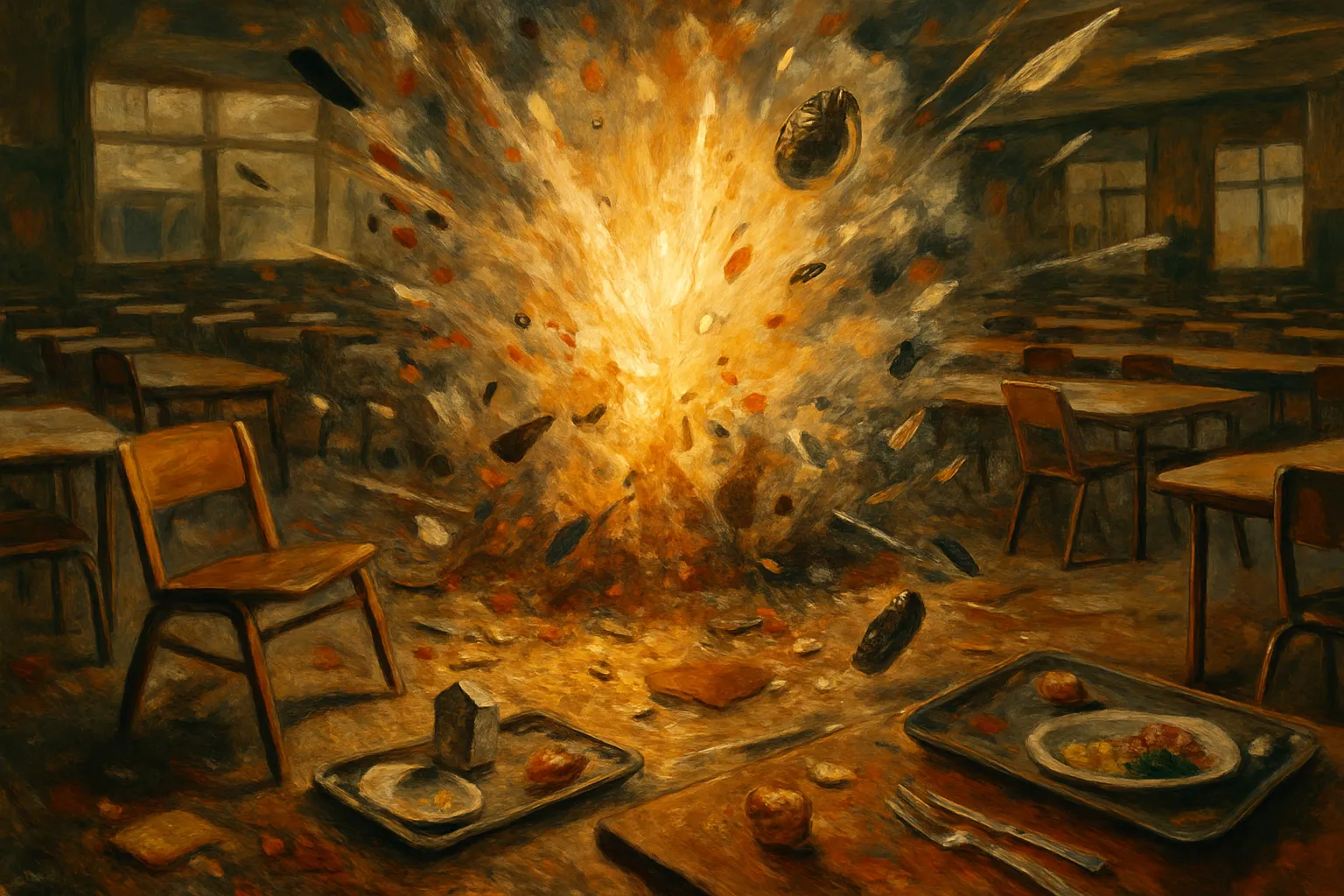
This piece is a surreal, intense decomposition of the subject's consciousness within the repressive social space of the lunchtime cafeteria, which functions as a machine of conformity. The narrator’s experience is not one of simple social anxiety, but a violent, literal fissioning of the self as a protest against the enforced order. The prose maps a psychological breakdown onto a physiological catastrophe, where the body's flows (blood, bone, organs) are physically rejected from the self and processed by the cold logic of the social structure (the dean, the detention ticket). It is an exhaustive study in anti-social existence, where the ultimate gesture of freedom is the disintegration of the body into fragments.
Lunch
Lunch: Twelve Fifty Eight P.M. Green table. Empty. Sat down. Peel away the territorial skin. Fall day. Seasons rearrange. Dispersed as deemed fit. Survival of the roaches. Anti-social tendencies. She sat. She asked. I didn’t know. I said so. Chains, the static codification. Not a single line of flight to hang. Red bow tie. Stooge. Doesn’t exist. Good-by. Slow. Bleeding pace. Trails of pure fear into the too-bright day. I’m here. She across. I forced two sentences today. They leered. I choked. Blood came out. Covered green table. Smiling bloody lips. Harmless buzzing machine noise. Seems ironic. They are the non-stop flow. Zip, zip. Chip, chip. The small hammer lodged in the spinal axis. I laughed. Came out sparkling. I am becoming-bitter-night. I feel strangely joyous in my gothic martyr fission. I could fly. Off my wings with piano wire. Lovely dirt. Dirt and grit, a kind of lumpy soup.
Lunch: One Oh Three P.M. Green table. I walked here. I sat. I watched them watching me. I withered. She sat. I embraced my scars. She reads. I write. Silence here. Nowhere else. Green table. Green circular table. It rotates. I follow it with my eyes. Dizzy. Life spinning. Hair growing after death. Become roots. We are seeds. I wish to bleed. To bloom. Flowers make me sneeze. Burn the garden. The floral territory is a lie. Cancer, it spreads. Angelic. It loops, moves on its own accord. Relevance.
Lunch: One Thirteen P.M. Cold, bitter. Wrapped in my shell. Tough. Cold leaks, bleeding. Bitterness finally deterritorializing. Grenade in my pocket. Pin in my mouth. She sits. She reads. She pays no attention. I become paint. Red ink blots of self-portraiture on the wall. The therapist asks, “What does this look like?” I say, “it’s me fissioning.” Bone-fragment bounces across the floor, to the wall. Stop. Satisfaction. It smiles, it shines. It is the lower half of my femur. Marrow leaks. Blast pattern. Scorch mark. No smoking. I received a ticket. He tossed it on the pile of me next to my left lung. My ear landed in her hair. She brushed it off. It hit the floor. She kicked it under the table. My right molar landed in a bread bowl. “MY SOUP!” the girl screamed. She ran to get a refund, and then sat back down. Bell rang. They filed out. Tiptoed between blood, cloth and organs. The dean shoveled me up. Put me in a disposal machine and rolled me to the office. He gave me a three hour Saturday detention. Insubordination.
Lunch: One Twenty P.M. I stood. She stood.
Interpretation
The entire narrative maps the lunch period onto the lifecycle of a Social Machine designed to process and neutralize singularity.
The Repressive Apparatus (The Socius): The "green table" and the communal space represent the initial, fragile territory (the Socius) where desire must be coded into acceptable social interactions (small talk, politeness). The narrator's "anti-social tendencies" are not personality flaws but the subject's pre-programmed resistance to this coding. The social pressure manifests as "Chains, the static codification," which trap the subject without providing the release of death (not a noose to hang)—only continuous, sterile existence. The "buzzing machine noise" and incessant talking symbolize the Non-Stop Flow of standardized, meaningless communication that the narrator must endure.
The Body Without Organs (BwO) and Fission: The central action is the deliberate, internal rupture of the subject. The self chooses fission over forced coherence. The choking and subsequent bleeding are the body physically rejecting the imposition of language ("I forced two sentences today") and social flow. The blood covers the green table, symbolizing the BwO surfacing, coating the clean social territory with intensive, disorganized flows of life and pain. The ultimate BwO moment occurs when the subject becomes "bitterness finally deterritorializing" and the body is willfully disassembled: bone fragments, lungs, an ear, and a molar all become disconnected, singular desiring-machines running on their own intensive paths across the floor.
Lines of Flight and Affective States: The desire to escape the machine is expressed as a yearning for Lines of Flight. The hammer in the spine is the repressive mechanism, but the subject laughs, and the fear "Trails of pure fear into the too-bright day" is a line of flight that fails, running into the oppressive brightness of the social order. The "gothic martyr fission" is the subject’s ecstatic, joyous becoming-imperceptible—the ultimate liberation is achieved not through physical exit, but through decomposition and schizo-fragmentation.
The Disposal Machine: The final act confirms the institution's function as a Disposal Machine. The other students "Tiptoed between blood, cloth and organs," showing they are perfectly disciplined and conditioned to ignore flows that violate the social code. The Dean, the literal agent of the Socius, simply shovels the remains into a disposal machine (the trash can) and issues a ticket for Insubordination. The subject's total physical and emotional disintegration is thus reduced to a bureaucratic offense, demonstrating the machine's absolute power to re-code even radical self-destruction back into a trivial administrative failure. The quiet ending ("I stood. She stood.") suggests the cycle is complete and ready to repeat.
Comments
Post a Comment