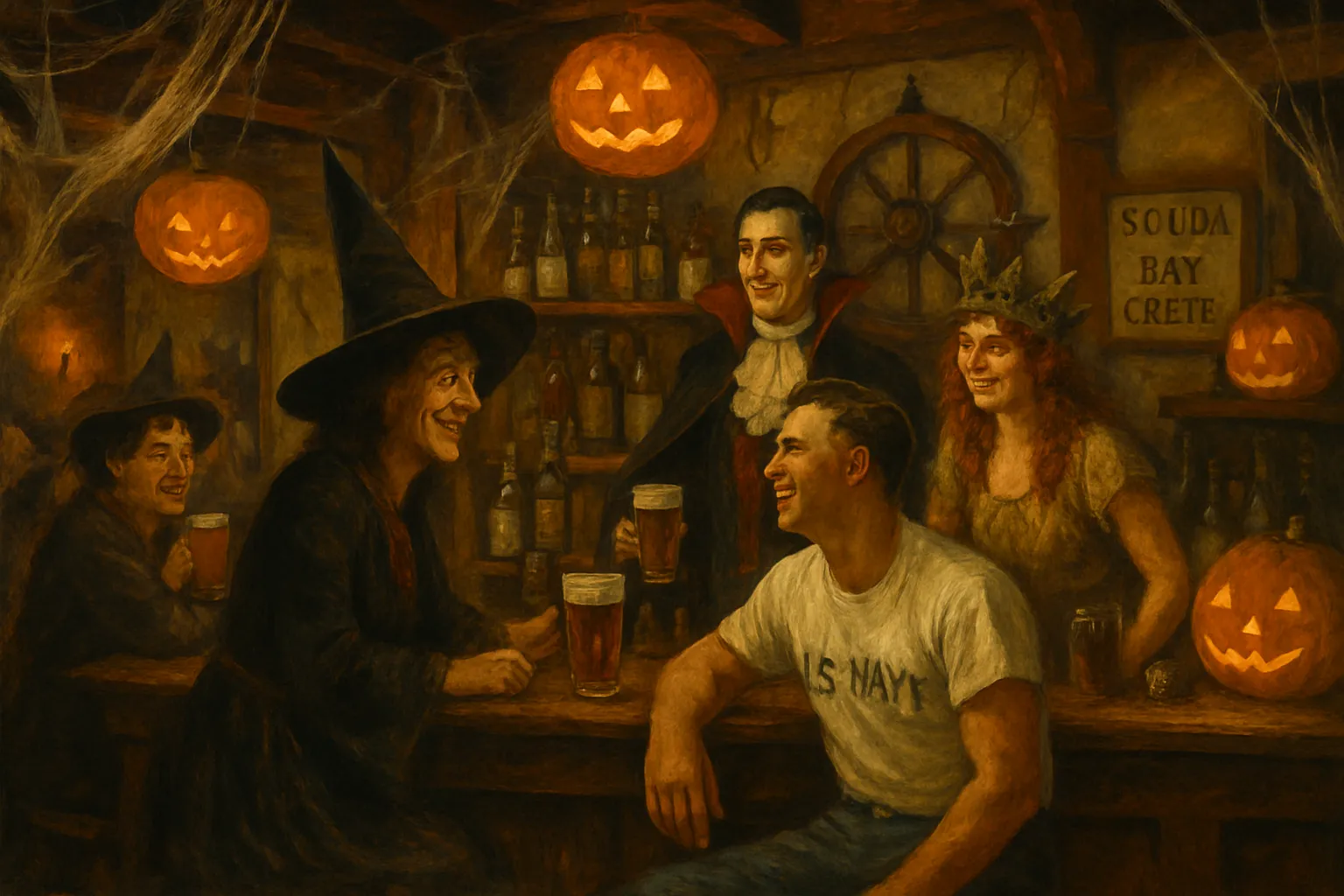
Welcome to the shattered mirror of shore leave. This poem captures the visceral whiplash of a naval deployment—the sudden, unstable release from the ship's ordered chaos into the chaotic freedom of a foreign port. Set in Suda Bay, Crete, the speaker filters the cultural spectacle of European Halloween through a lens of cynicism and existential fatigue. It is a chronicle of permission granted by the military to externalize the internal damage, where the search for "pretty British bartenders" and "giant glass boots" is a desperate, temporary attempt to reterritorialize desire before the anchor is weighed again.
Off-Duty
The bus shuddered, climbing from the ship toward the city.
Jimmy smashed the small flea
against the windowpane—a tiny, decisive execution.
I almost offered the reminder:
God is watching,and shrooms don’t help the beer go down.
This isn't Spain; this is Crete, a bitter island desert
screaming histories of turmoil and ancient heat.
Stone buildings collapse not from age, but because certain men,
who learned their hatred by rote, learned also
the operational language of the target.
The U.S. Navy grants us a temporary charter:
permission to piss on storefront windows,
to scream blasphemy at pretty, foreign girls
dressed in cheap Halloween satin, serving beer
in ridiculous, oversized glass boots.
We turned down a narrow alley, the air suddenly cool.
There, sprayed in desperate red on a wall,
was the simple, brutal advice: "DIE MARINES DIE."
It was a direct order, a flow of pure contempt.
It did not deter our drunken gang. We just laughed
and kept moving toward the next open door.
After two weeks of sheer, cold transit across the pond,
every girl’s eyes seem full of the ocean—
deep, deceptive, and reflecting only our absence of shore.
Jimmy killed the flea because he cared.
He cared about controlling the smallest,
most irrelevant detail of the immediate frame.
The small war continued, window to window.
Interpretation
The bus ride from the ship toward the city represents a crucial phase of deterritorialization—the physical movement away from the rigid codes of the ship, preparing the subject for the temporary, chaotic freedom of liberty. Jimmy’s immediate execution of the flea is not merely a symbolic act, but a necessary micro-cut that affirms the subject’s control over the smallest flow of life, proving the internal military logic persists even off-duty. This obsession with controlling the "immediate frame" signifies the subject's inability to exit the paranoid machine.
The perception of Crete as a "bitter island desert screaming histories of turmoil" reveals that the exterior territory is immediately encoded through the lens of trauma and operational conflict. The collapse of the stone buildings is attributed not to time, but to a shared "operational language" of destruction—the military mind recognizes the fundamental sameness between its own methodology and the terrorist flow it is fighting. Both forces are perceived as speaking the same destructive code, making the military mission an exercise in confronting its own mirrored violence.
The inclusion of the graffiti, "DIE MARINES DIE," is a direct, unfiltered flow of political hatred aimed at the military apparatus. It is the raw, unsanctioned output of the local socius expressing pure contempt. The drunken gang's laughter and refusal to be deterred signifies the military subject's schizophrenic invulnerability: the direct threat is acknowledged ("a direct order, a flow of pure contempt") but immediately dismissed because the sailors are already operating within the protective, temporary, and self-destructive charter granted by their own system. They are too focused on the low-level chaos of liberty to heed the high-level warning.
The Navy's "temporary charter" is the mechanism of controlled schizophrenic release. This permission—to engage in profane and aggressive acts—serves as a sanctioned output for the built-up pressure in the desiring-machine, preventing total systemic failure. The pursuit of the costumed bartenders and the oversized glass boots is a search for an exaggerated, artificial output that can momentarily overwhelm the reality of deployment. The final image, where the foreign girls' eyes reflect the ocean, signifies the ultimate absence of stable territory. The desired flows (love, belonging, shore) are merely reflections of their own endless transit and emotional absence. Jimmy’s final, meticulous execution of the flea confirms the core thesis: liberty is not freedom, but a continuation of the "small war," where the only solace lies in the precise, paranoid affirmation of control over the minute chaos.
Comments
Post a Comment