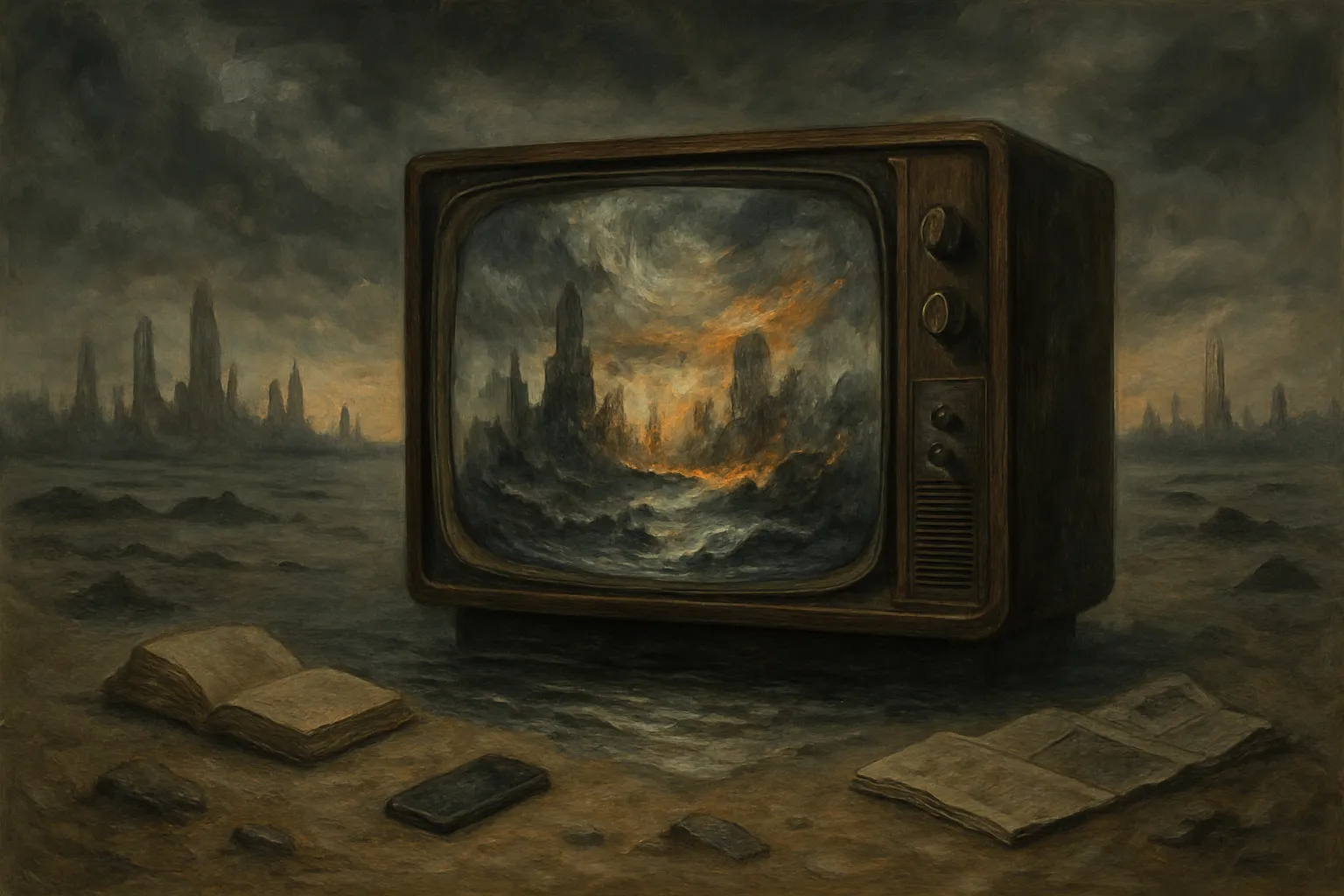
Every social interaction in this poem is a financial debt and every person is a disposable commodity. This poem presents a terrifying fusion of entertainment and annihilation, where the electrocution of criminals is packaged as an "after-school special" and advertised alongside nihilistic commercial messages. The setting is one of total media saturation, where the spectacle of death and the product meant to alleviate loneliness (whiskey) run on the same continuous loop. The distinction between public service, commercial appeal, and absolute self-destruction is completely erased, leaving the viewer trapped in a cycle of passive consumption that trivializes every meaningful experience—from death to heroism.
Televised Apocalypse
Drama caused by a downed
power line starts
A new after-school special.
Where children watch criminals sit
In wooden chairs
And mutter
Final, unprocessed words.
The switch CRACKS.
Hair stands erect on the arm of the viewer,
while souls sparkle—
a brief flow of static energy—
and flesh melts.
Every choice-node fires, creating
a new, parallel universe
of unwatchable consequence.
The commercials between
zaps—computer-generated
talking animals advocating
whiskey as the only viable solution
to a child’s
unspecified structural loneliness.
Slit your wrists now!
Save us the
electric bill.
Even though
everything tastes
of industrial coolant and burnt wire
You are still capable of:
getting the girl
saving the world
showing your friends
how cool your market-coded despair is.
Everything is all right.
Regular broadcasting
of the loop
starts again at
5pm.
Interpretation
The poem is a chilling map of the capitalist media machine, showing how it absorbs and recodes all forms of life, death, and emotion into commodity flows. The entire structure of reality is a continuous, self-stabilizing loop of consumption and violence.
The spectacle of death is now your Saturday morning cartoon. The television functions as the central desiring-machine of the poem, producing a lethal flow of spectacle. The execution is not a legal act but a dramatic after-school special—a time slot coded for moral instruction. By showing the death of criminals, the machine recodes the flow of justice into the flow of entertainment. The details—"The switch CRACKS," "souls sparkle," "flesh melts"—describe the physical disintegration of the body, which, in schizoanalysis, is the ultimate deterritorialization of the organism. This death is immediately reterritorialized into an aesthetic effect (sparkling) that feeds the media flow.
Every choice you could make is immediately rendered obsolete by the screen. The line "Every choice-node fires, creating / a new, parallel universe / of unwatchable consequence" is a high-level description of the schizoanalytic principle that reality is a continuous, proliferating production. Every input (choice) creates a flow, resulting in an infinite number of productive machines. However, the media machine immediately re-codes this infinite possibility into "unwatchable consequence"—meaning, the true, complex flow of reality is suppressed in favor of the controlled, simplified flow of the broadcast.
Your deepest structural loneliness is just another sales opportunity. The commercials are the purest form of the Capitalist Code. They are perverse desiring-machines, advocating for self-destruction ("whiskey as the only viable solution") to address a societal failure ("unspecified structural loneliness"). Loneliness is not a personal failure but a product of the social structure; the machine sells the cure (liquor) for the sickness it produced. The command "slit your wrists now!" is the ultimate cynical flow, equating self-harm with an economic calculation ("Save us the / electric bill"). The individual is reduced to a cost center.
Even your rebellion is just a product line extension. The poem outlines the false promises used by the Socius to reterritorialize the subject's despair. The nihilism ("everything tastes / of industrial coolant and burnt wire") is immediately countered by the generic, marketable narratives of success: "getting the girl," "saving the world." The final absurdity is that the individual's deepest agony is given a price tag: "how cool your market-coded despair is." The self is trapped: even rebellion (despair) is just another consumer identity. The cycle completes with the "regular broadcasting / of the loop," confirming that the illusion of reality is endless and that the violent flows are simply components of a perpetual program.
Comments
Post a Comment