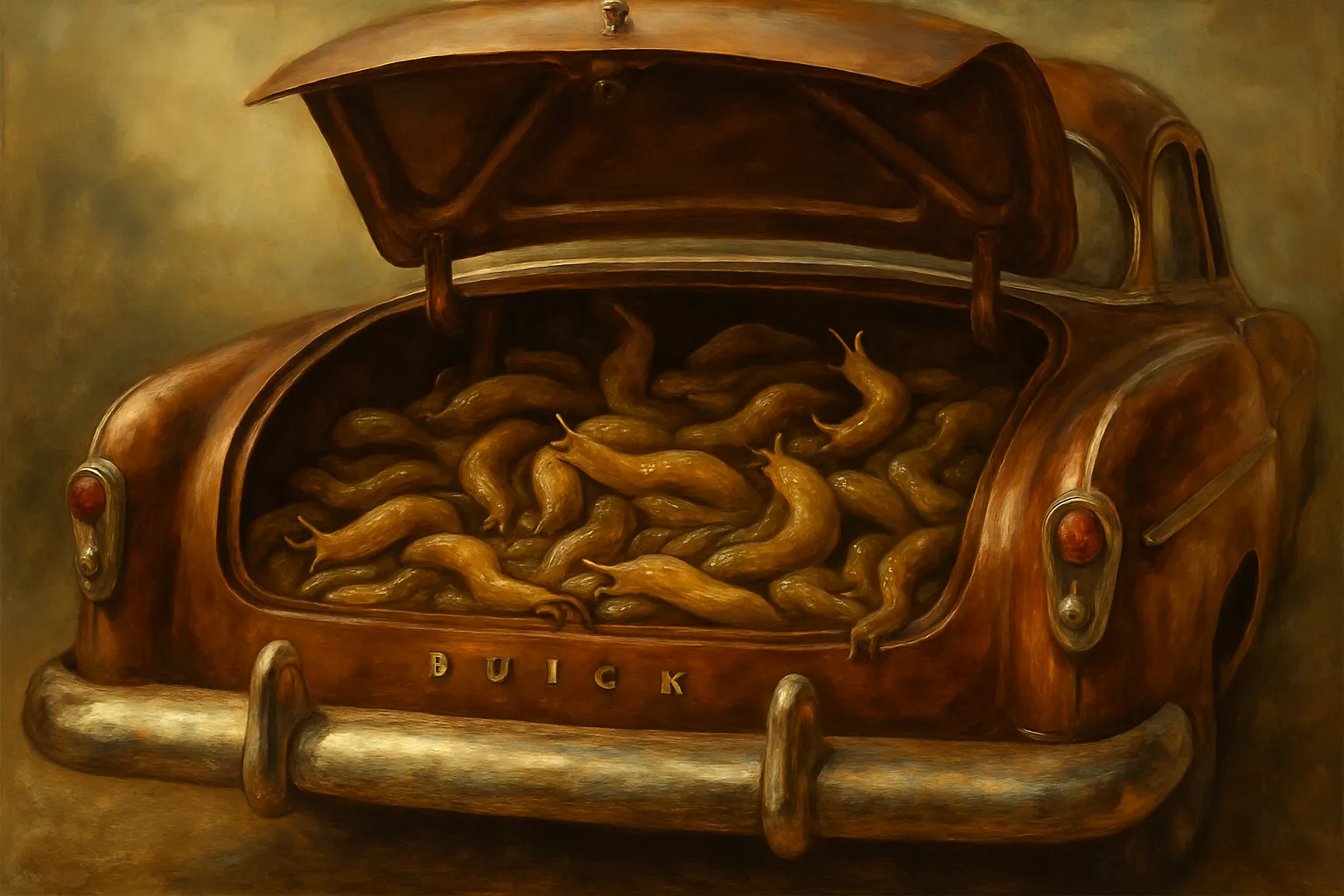
This poem brutally merges the visceral horror of the trenches with the domesticized electric shock of suffocation, narrated with raw, detached physicality. It portrays a relationship not as a tragedy, but as a violent, necessary physical processing of a spent emotional machine. The imagery moves from the slow, corrosive reality of the "filth-flow" to the highly charged metaphor of a body as a "rage-doll" powered by misfiring systems. The final, definitive action is a cold, functional gesture of disposal, reducing the partner from a person to a "heavy sack" to be folded into the "dead brown Buick," completing the mechanical disengagement.
Slugs
The slow, uncoiling filth-flow.
Leaden fidelity wraps her neck
like a trench-wire charm.
My fingers tickle
her rage-doll lungs—
they are cracked bellows, stale air.
Fireworks misfire behind the sugared target of my mind.
Her eyes went strobe light.
I stooped over the body,
over her smoke-ringed aurora.
I took the keys.
Left the money.
Unnecessary weight.
I dragged her by the wrists— functional weight—
and folded the whole heavy sack
into the dead brown Buick.
Interpretation
The poem is a functional description of the Love-Machine breaking down, where the narrative voice enacts a Deterritorialization of the relationship and the self.
The Initial State: Filth and Consumption: The opening image, "Slugs. The slow, uncoiling filth-flow," immediately establishes the relationship not as an ideal, but as an intensive, corrosive material—a flow of low-grade, inescapable degradation. The "leaden fidelity" is a shackle, a static code imposed on the body, rendering the commitment as heavy, cheap jewelry, like a parasitic "trench-wire charm" clinging to life in the mud.
The Broken Desiring-Machine: The description of the body is purely mechanical. The "rage-doll lungs" are cracked bellows, signifying the lungs are no longer organs of life but of manufactured, spent energy. They are incapable of producing pure flow; only "stale air." The "fireworks misfire" in the narrator's mind—the desiring-machine is short-circuiting, collapsing the soft, aesthetic "sugared target" (the heart/ideal) into a useless, romantic aesthetic. Her eyes going "strobe light" signifies the complete deterritorialization of vision—the flow of reality is reduced to fragmented, unreadable pulses.
The Functional Cut: The narrator's subsequent actions are pure, cold economy. The decision to "take the keys" and "leave the money" is an unromantic calculation, labeling the money as "Unnecessary weight." This is the moment the subject chooses utility over sentiment. Dragging the body by the wrists transforms the partner into "functional weight"—a heavy sack of residual flows that must be disposed of. This act is the ultimate Cut separating the narrator's trajectory from the machine's debris.
The Disposal and Final Coding: Folding the sack into the "dead brown Buick" is the final act of recoding the remains. The car itself is a static object, a neutral, sealed container used to remove the excessive, failed flows of the relationship from the shared territory. The poem ends by affirming that love, once broken, is nothing more than a dense, inert mass that requires cold, brutal mechanics to be effectively eliminated from the subject's life.
Comments
Post a Comment