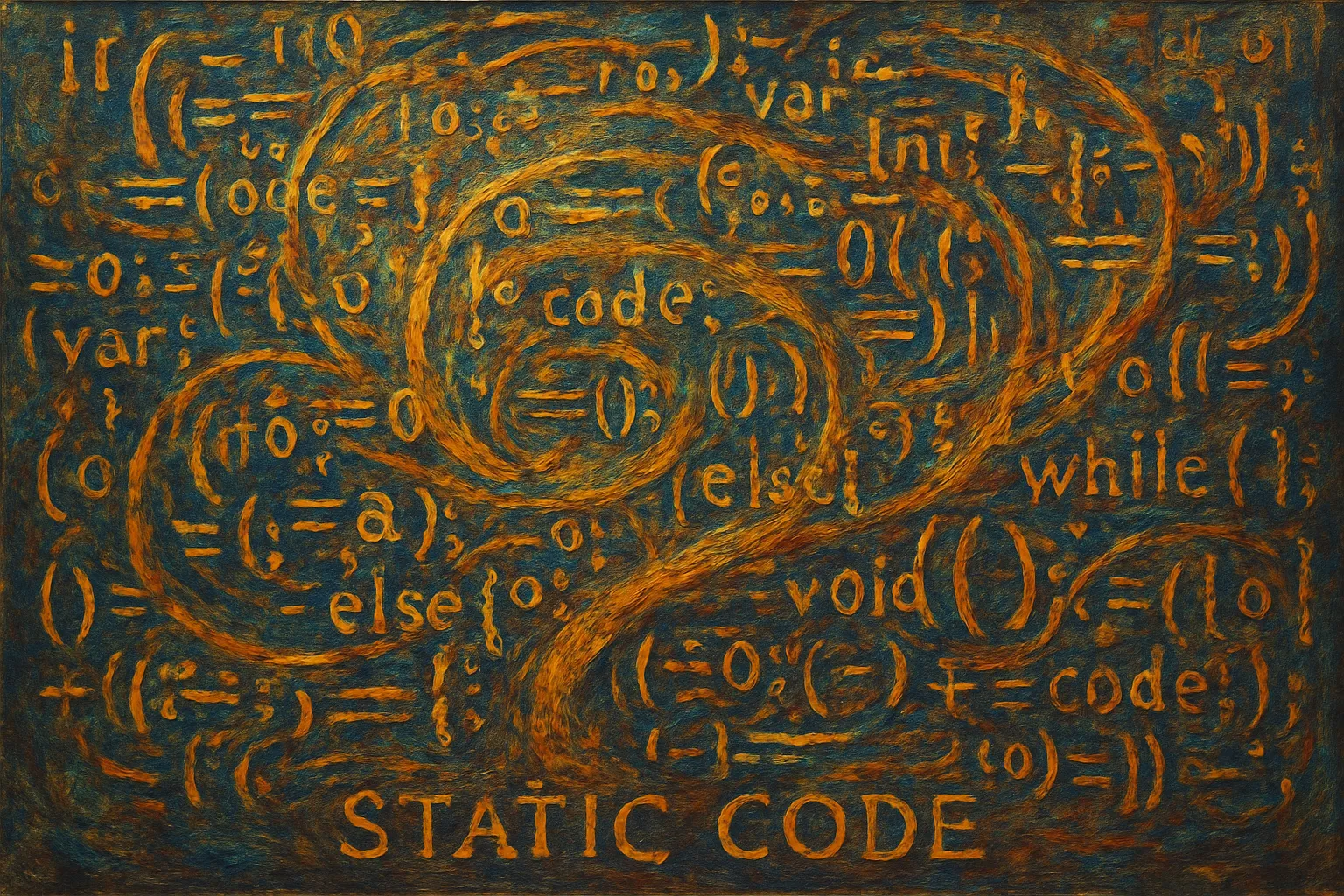
This poem functions as a sterile, deeply unsettling encounter between two subjects defined entirely by their social coding—one by perceived white supremacist aesthetics, the other by urban youth style. The setting is a moment of stasis broken by an existential interrogation ("Are you coded for violence?"). The poem strips identity down to a list of commodities (boots, chains, shoes) and attitudes (staring, boldness), revealing that the only real difference between the two subjects is the type of machine they are plugged into. The narrator's final, jarring response—the fixation on a blister and the absurd question of whether the pain has "monetized yet"—is the ultimate expression of alienation: even physical suffering is viewed through the lens of economic transaction.
Static Code
White male.
18.
Shaved head.
Khakis, faded holes.
Black boots, steel-toed necessity.
Chain, waist to pocket.
Shoes, duct-taped refusal.
I sat, against the wall.
Cross-legged.
Staring at the non-flow.
Black Male.
17.
Blue jeans, low-hanging.
Clean crisp, white shoes.
Silver chain, hanging
from neck, past his signifier.
Hair short. Ruffled.
He walks up.
Stands at
My feet.
"Are you
coded for violence?"
Eyes wide.
Strong. Bold.
Looking down into
My stubble.
I took
My shoe off.
And looked at the bottom
Of my foot.
"What are
You doing?"
Half turned.
Lip curled.
"This morning
I pulled off
A blister.
I needed to see
if the pain
had monetized yet."
Exhaustive Schizoanalysis Interpretation
This poem is an exhaustive study in how social machines assign static codes to bodies, leading to a profound deterritorialization of authentic experience, where the only language left is that of commodity and violence.
1. The Coding Machines (Territorialization)
The poem's first half is a list of codified identifiers used by the social machine (the Socius) to categorize and contain flows of desire. The subjects are not named; they are defined by their accessories, which function as uniforms:
White Male: "Shaved head," "Black boots, steel-toed necessity," "Chain, waist to pocket." This attire is a static code of radical political or anti-social affiliation. The boots are not protection; they are a necessary component for the potential flow of violence.
Black Male: "Blue jeans, low-hanging," "Clean crisp, white shoes," "Silver chain, hanging / from neck, past his signifier." These elements form an equally rigorous, though different, territorial code linked to cultural signifiers of status and style. The chain is an excess flow, but one that is instantly recognizable and coded by the media and society.
The fundamental conflict is a collision between two highly territorialized codes, where each subject recognizes the other only as an assemblage of clothing and attitude.
2. The Failed Flow and Interrogation
The narrator begins by "Staring at the non-flow," a moment of schizophrenic stasis where the machine of desire has temporarily ceased production. This stillness is broken by the interrogation: "Are you / coded for violence?" This question is the social machine speaking through the Black Male's body. It asks not about intention or morality, but about the subject's pre-assigned function within the social distribution of violence. The White Male is suspected of being a desiring-machine specifically built to produce hate-flows.
3. Deterritorialization and the Monetary Body
The narrator's response is a radical act of deterritorialization, diverting the high-stakes interrogation into the mundane, internal flow of the body. By removing the shoe, the narrator shifts the focus from the social code (the boots) to the raw physical body. The act is a perverse form of self-analysis, replacing philosophical inquiry with corporeal attention.
The final question—"I needed to see / if the pain / had monetized yet"—is the ultimate endpoint of Hyper-Capitalist Deterritorialization. All flows, including the most basic organic flow (pain from a blister), have been reduced to commodity flows. The pain is not an internal state to be healed or felt, but a resource to be checked for its exchange value ("monetized"). The narrator is alienated not just from society, but from his own sensory experience, confirming that in this world of pure code, even the Body Without Organs (BwO) is forced to operate under the logic of the market machine. The question marks the final absorption of the self into the economic code.
Comments
Post a Comment