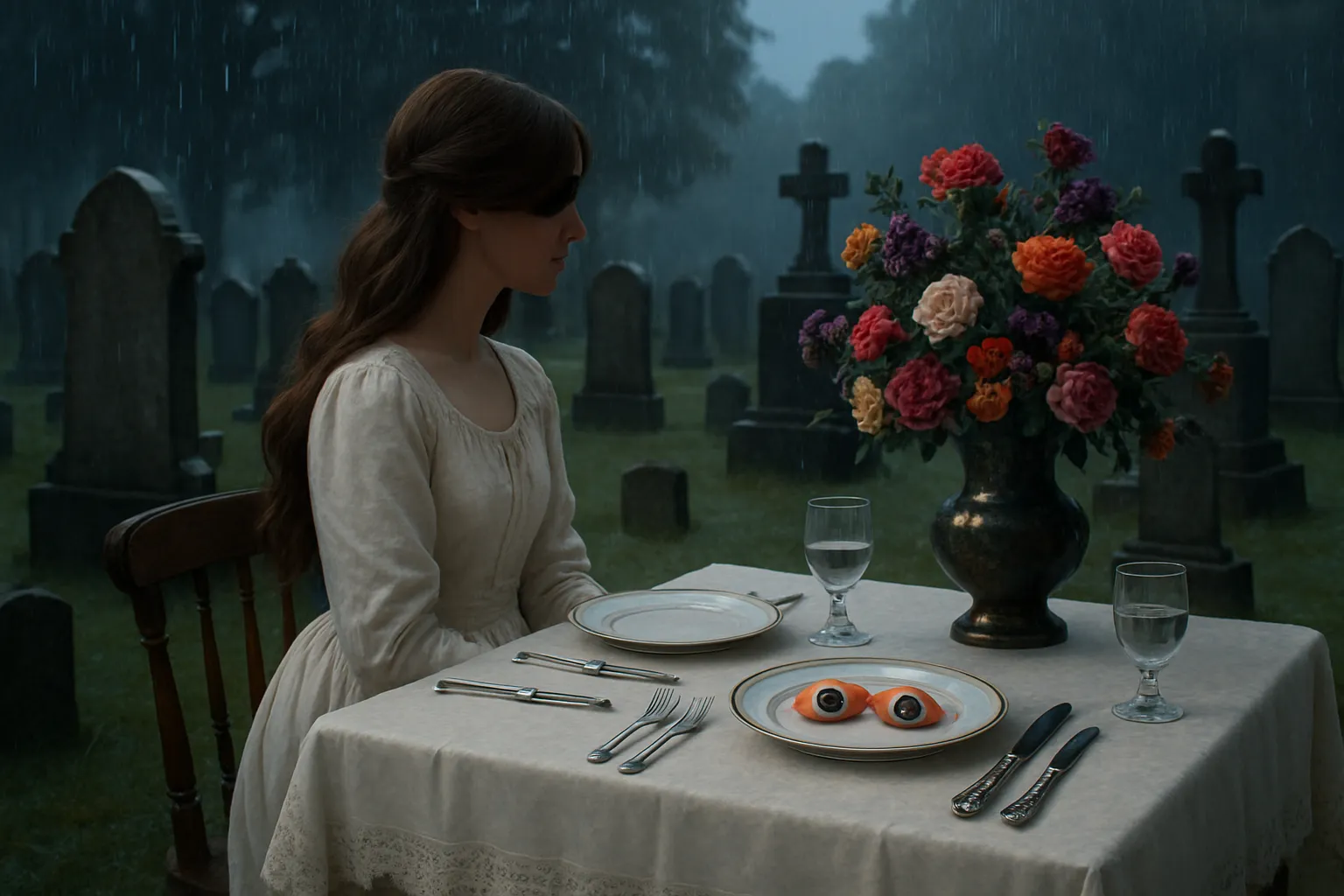
All skin is a fragile boundary waiting to be breached, and the deepest ecstasy is found in the wound. This text transforms a moment of intimate contact into an act of grotesque, philosophical violation. It is a descent into the body as a site of sacrificial art, where the narrator seeks not union, but the horrifying knowledge contained within the subject's disassembled form. The transgression is an explicit act of defiance against a structured, moral universe, culminating in a chilling, objective presentation of detached human matter.
Midnight
She dragged her hair back. Her fingers became part of my scrawl— These words holding the NOW in the constant, a scripture etched onto the present moment.
The river of her skin, dimpled and razor-soft. I thought to brand her neck with my print, warping her eyes and lips. The midnight design etch-a-sketching stars— mapping the void onto her living surface.
I mingled my soul with her eyes, and chiseled her breasts— concentrating on the sin as an act of defiance to a god-sparked dimension.
A cross hung low around her neck, between my lingering, possessive fingers. I excised her eyes and set them on a wooden stool. Her precious red nerve endings still twitching. Witnesses to a horror they cannot process.
Interpretation
This text abandons conventional romance for a Barker-esque exploration of metaphysical sadism and the horror of creation. The narrator's actions are driven by a desire to reach a transcendent, forbidden truth through the violation and reconstruction of the body.
The initial image is intensified: "She dragged her hair back" replaces the weaker "limped her hair back," suggesting a rougher, more desperate gesture that exposes the neck. The skin is "dimpled and razor-soft," combining vulnerability with the threat of cutting. The narrator's thought moves from merely "fingerprinting" to "brand her neck with my print," making the act explicitly possessive and painful. The line "between my lingering, possessive fingers" replaces "my lingering fingers," cementing the psychological violation before the physical one.
The core of the transgression is the artistic mutilation. The narrator "chiseled her breasts," transforming the traditional symbol of nourishment and life into a cold, sculpted object. This violence is not random; it is a ritualistic act of defiance against a conventional "god-sparked dimension." The focus on "sin" makes the act a deliberate challenge to morality, suggesting that true knowledge (pleasure and pain inextricably linked) lies beyond the constraints of divinity.
The climax involves the eyes. "I excised her eyes" is a concrete, surgical term replacing the more passive "took out," emphasizing the cold, precise nature of the mutilation. The presence of the low-hanging cross emphasizes the sacrilege of the act, with the religious symbol lying directly between the narrator's hands and the impending horror. The detached eyes, now mere "Witnesses to a horror they cannot process," are set on a stool. The final, lingering detail—the "precious red nerve endings / still twitching"—is pure body horror. It focuses clinical attention on the residual life of the severed, exposed flesh, confirming that the narrator has succeeded not only in destroying the subject's identity, but in capturing the raw, agonizing, exposed mechanism of her being.
Comments
Post a Comment