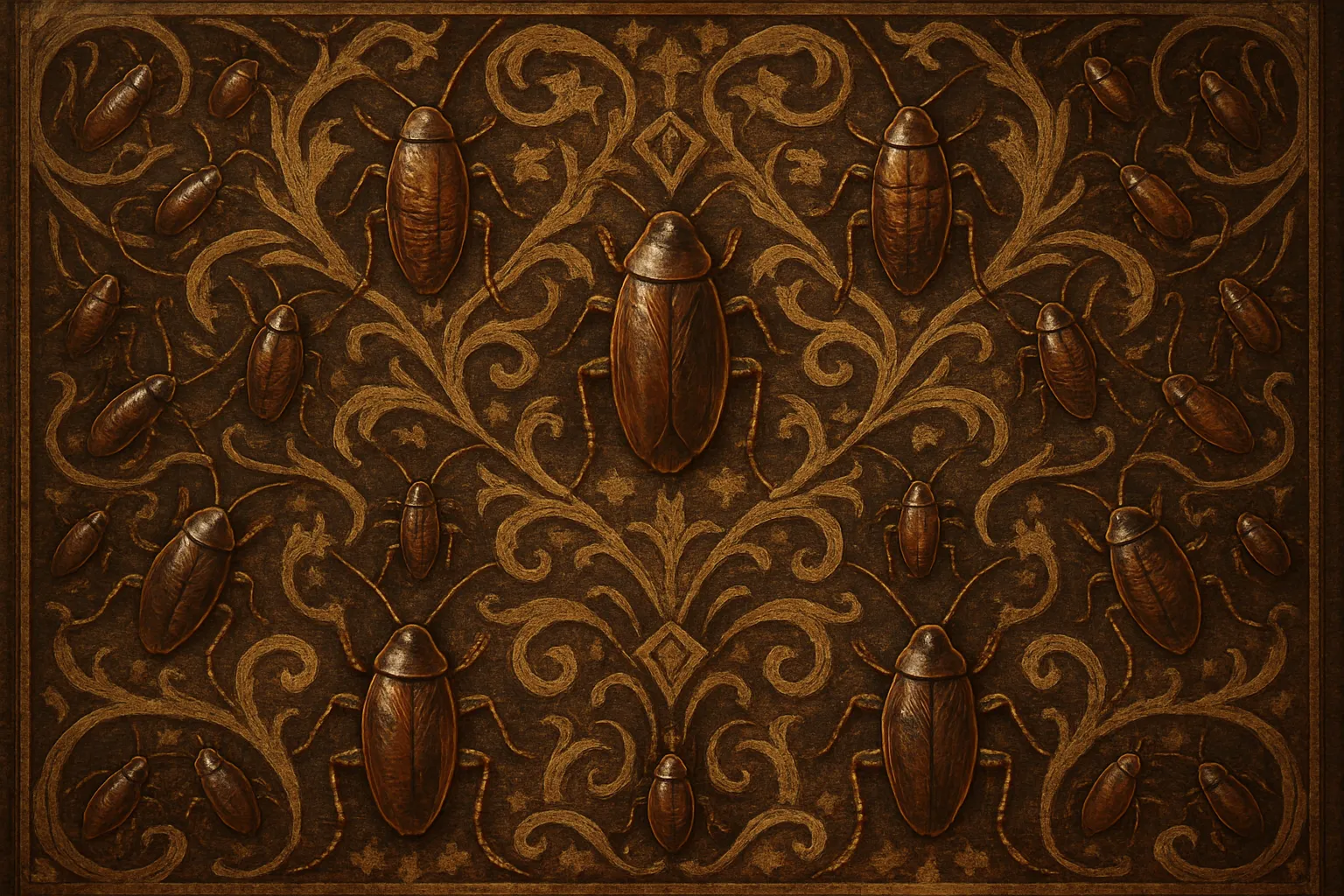
Welcome to the breakdown: your mind is being eaten by roaches, and your home is attacking itself. This poem plunges the reader into a scene of extreme psychological and physical disintegration, fusing the intimate space of a bedroom at 3 a.m. with images of infestation and architectural violence. It combines the horror of internal decay (the roaches consuming the mind) with the horror of external action (the figure mutilating the room). The work provides a perfect starting point for schizoanalysis because it presents the human body and its environment not as stable, fixed entities, but as interconnected, failing desiring-machines and territories that are constantly being broken down and violently recoded.
Necrosis
Roaches, a tapestry
Sewn
Her hair
Prickly legs
Scuttling through
Gray matter
At 3 a.m.
Closet creaks—
The door sighs open.
She comes
Raised hands
Wiggling needles of bone
Piercing out
Her tips, fingers
Flaying drywall to bone
Onslaught
Writings, wall
Flesh scratched raw
Piles of plaster
Bulb intact
Swings, a ligature of wire
Incense smog
Brittle glass
Breathe
Another cycle of rot
Tongue drips
Over lip
A slick, slow flow
Hell clutched
Be the skin you wear, forever.
Interpretation
"Necrosis" functions as a violent instruction manual on schizoanalysis, forcing us to abandon traditional notions of character and setting and instead focus on how systems—or desiring-machines—produce reality through continuous movement, or flows.
In schizoanalysis, desire is production; it is not about what we lack, but what we continuously create. The poem immediately establishes several destructive desiring-machines. The first is the Roach/Hair Machine, introduced in the opening lines. The roaches are not just insects; they are a micro-machine that interfaces directly with the human brain ("Gray matter"). This machine produces a slow, consuming flow, turning biological life (hair) into a "tapestry" of infestation—the flow of internal madness literally being sewn into the subject's physical being.
The second machine is the Self-Mutilating Machine, embodied by the figure’s actions. Her hands, armed with "Wiggling needles of bone" (her fingers) are no longer for normal human function but are instruments for producing the flow of violence. This machine is connected to the environment, as its primary product is the destruction of the wall, turning a stable object into "Piles of plaster." This action confirms that the body is simply an interface, a tool dedicated to converting internal torment into external, physical output.
The most intense process in the poem is deterritorialization, which is the violent breaking down of established codes and boundaries. The setting of the room is the domestic territory—a space coded for safety, stability, and control. The figure's entrance ("The door sighs open") and subsequent actions violently deterritorialize this space. She converts the drywall (a solid code of domesticity) into "Piles of plaster," transforming the room from a territory of shelter into a fragmented terrain of destruction.
Simultaneously, the body is deterritorialized. The phrase "Flesh scratched raw" suggests the ultimate breakdown of the skin—the most basic code separating the interior self from the exterior world. The body is merging with the wall, becoming indistinguishable from the destructive territory. Furthermore, the light bulb, swinging as a "ligature of wire," is the social illumination becoming an instrument of binding and strangulation, signifying that the oppressive forces of reality are now intrinsic to the room's very structure.
The Body Without Organs (BwO) is a plane of pure flow and intensity, a rejection of the organism's standard organization (where organs have specific functions). It is a body of sensation and potential.
The act of flaying the wall turns the figure into a kind of BwO—a body defined by a single, destructive intensity (scratching) rather than conventional function. The "Tongue drips / Over lip / A slick, slow flow" represents an intense, unorganized bodily flow. It is a detail that serves no communicative purpose, but is pure, excessive production—a flow of saliva/madness that simply is.
The poem concludes with a powerful, final act of reterritorialization, or recoding. The chaotic flows of violence and psychic breakdown are stabilized by the metaphysical weight of "Hell." The final command, "Be the skin you wear, forever," is the ultimate code of imprisonment. The skin, which was briefly deterritorialized when it was scratched raw, is now repurposed as the eternal, inescapable territory of suffering. The figure is condemned to a hell that is not an external place, but the very boundary of her being, ensuring her suffering will be self-contained and continuous. The system has stabilized the madness by making the body its permanent, private prison.
Comments
Post a Comment