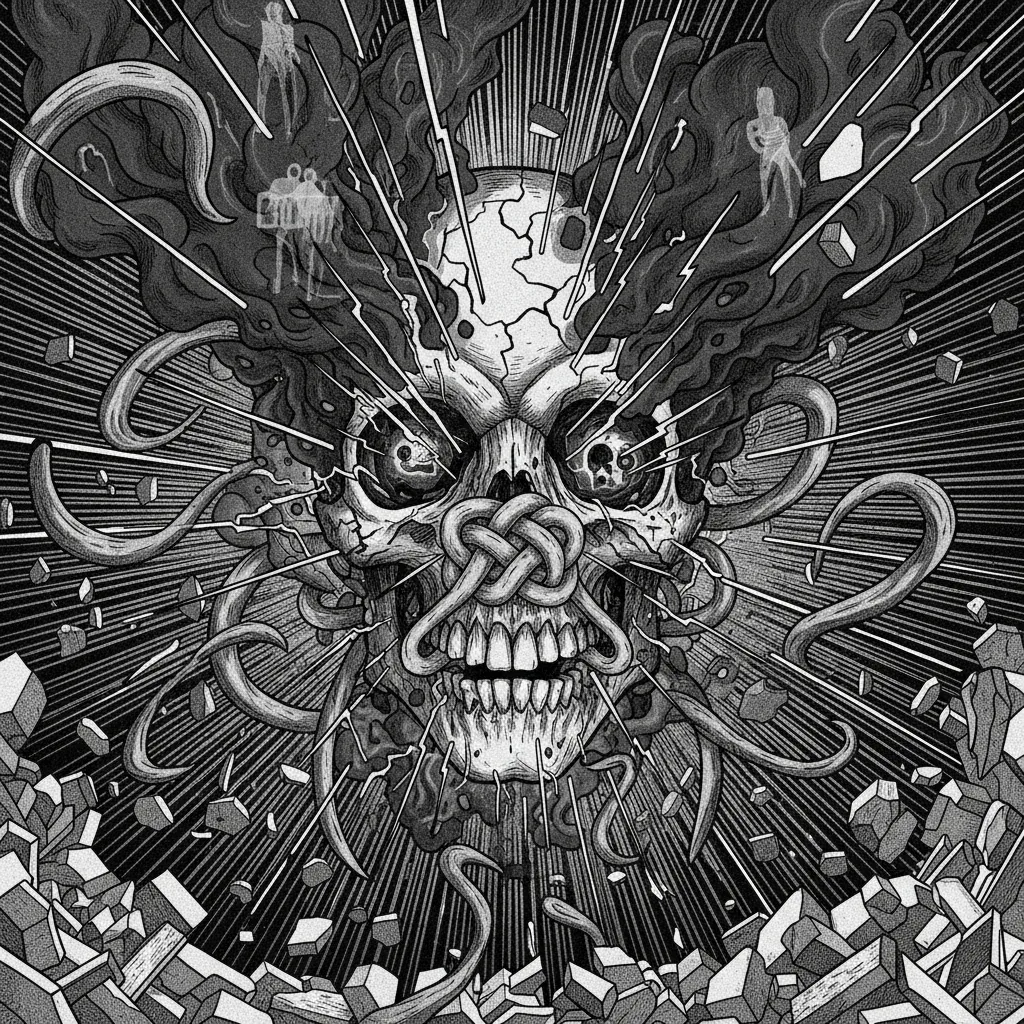
Years ago, I stumbled across a brief poem pinned to a corkboard at a philosophy club meeting—just a cluster of cryptic lines, wedged awkwardly between event notices. No title, no name. Yet something about its jagged, visceral imagery kept echoing in my head. It reminded me that sometimes, a dozen words can hit harder than a dozen pages. Today, I want to introduce 'The Terminal Compression,' a short poem that manages to squeeze anguish, theory, and raw experience into a single, crushing event. We'll keep things simple: I'll share the poem, offer a gut-level take, and then gently peel back the layers (without turning it into homework).
The Poem as a Boundary (And an Invitation)
Sometimes the shortest poems leave the deepest scars. I remember the first time I encountered a poem that was barely a dozen lines, yet it unsettled me for days. There is something about the compression of language—how a few words can press so much feeling, memory, and thought into a small space—that lingers long after the reading. Short, intense poetry demands an unrushed approach. It asks us to slow down, to let each phrase echo, and to notice the boundaries it draws around meaning and experience. In this section, I want to share the full text of The Terminal Compression and invite you to read it as both a boundary and an opening—a threshold that marks the limits of the body and mind, but also an invitation to cross them.
The Terminal Compression
If I contract hard enough
I hear the Osseous Schiz
The skull's tectonic plates
friction on the Gray Flow
a white, serrated shard
pressing the Neural Uncode
No hope for molar relief
The muscle-flow tightens
Memory images flash
The final Oedipal Trace
squeezing
The world collapses to a squash
A Singular Event of Compression
At first glance, The Terminal Compression is brief and cryptic. The poem describes a body under extreme pressure, where the act of "contracting" becomes a way to reach the limits of selfhood. The speaker listens to the "Osseous Schiz"—a phrase that fuses bone (osseous) with a sense of splitting or schizophrenia. The skull, usually a container for the mind, is imagined as tectonic plates grinding and creating friction with the "Gray Flow," a likely reference to the brain's matter. This imagery sets the stage for a violent, almost surgical rupture ("a white, serrated shard / pressing the Neural Uncode"). The poem ends with the world collapsing, reduced to a "squash," as if the entire field of experience is compressed into a single, overwhelming sensation.
Theme and Meaning in Key Phrases
Osseous Schiz: This term stands out as a metaphor for the splitting of the self at the level of the skull—where thought and matter meet. It signals a breakdown of boundaries, a moment when the body and mind can no longer be separated.
Neural Uncode: Here, the poem hints at the unraveling of structured thought. The "uncode" is the point where the brain stops processing in its usual way, suggesting a collapse of order into raw sensation.
Oedipal Trace: This phrase brings in psychoanalytic language, referencing the last remnants of structured, familial desire and memory. Its "final" appearance marks the end of narrative and the beginning of pure affect.
The world collapses to a squash: The closing line is both physical and cosmic. It suggests that the intense compression of the self is so total that it brings down the entire world of experience, flattening it into a single, dense point.
A Personal Note
When I first read poems like this, I felt lost. The language was dense, the images strange, and the meaning elusive. But over time, I realized that the brevity is part of the impact. Short poems force us to confront the limits of what can be said. They create boundaries—between sense and nonsense, between body and mind—but they also invite us to cross those boundaries, to feel the pressure and the release. For readers new to experimental poetry, I encourage you to sit with the text, let the key phrases echo, and notice how the poem both contains and invites.
Sometimes the shortest poems leave the deepest scars.
Compression as Catastrophe
When I read The Terminal Compression, I’m struck by how the poem uses the idea of compression both literally and metaphorically. The language is tight, the lines are short, and every word feels squeezed for maximum impact. This isn’t just about physical pressure—it’s about the mind and body pushed to their absolute limits. The poem’s structure, imagery, and tone all work together to create a sense of catastrophic compression, where the boundaries between mind and body blur and finally break.
Compression
The poem opens with “If I contract hard enough,” immediately introducing the act of compression as both a physical and mental event. The word “contract” can mean to shrink or tighten, but here it also suggests a desperate attempt to contain something that wants to break free. The “Osseous Schiz”—a phrase combining bone (“osseous”) and split (“schiz”)—evokes the sound and sensation of the skull under pressure. The skull’s “tectonic plates” grinding against the “Gray Flow” (the brain) is a vivid metaphor for the mind’s struggle within the physical limits of the body. The compression is so intense that it becomes catastrophic, threatening to shatter the very structure that holds the self together.
Deterritorialization of Bone
One of the poem’s most powerful ideas is the Deterritorialization of Bone. In simple terms, this means the bone (the skull) stops being just a container for the mind and starts to lose its role as a boundary. The poem describes this as “not passive damage, but an active Deterritorialization of Bone, where the skull’s ‘tectonic plates’ grind against the Gray Flow.” Here, the skull isn’t just breaking; it’s being transformed. The mind is no longer safely inside—it’s spilling out, mixing with the body, and losing its old shape. This is where the poem’s imagery becomes most intense: the “white, serrated shard” and the lack of “molar relief” show that there’s no going back to wholeness or comfort. The body as boundary is undone, and the self is forced into a new, unstable state.
Neural Uncode
Another key term is Neural Uncode. Normally, the brain works by coding and decoding information—organizing thoughts, memories, and sensations. But in the poem, compression leads to a “Neural Uncode,” a moment when the brain’s usual order collapses. This is the point where structured thinking breaks down, replaced by raw sensation and fragmented memory. The “memory images flash” and the “final Oedipal Trace” are the last bits of narrative and identity, squeezed out by the overwhelming pressure. The poem sidesteps traditional storytelling, choosing instead to deliver a direct, visceral affect—a feeling that hits before it can be explained.
Fragmentation and Literary Devices
The poem uses literary devices like fragmentation and intense metaphor to heighten its effect. Each line is a fragment, a piece of a larger catastrophe. The imagery is sharp and physical: “serrated shard,” “muscle-flow tightens,” “the world collapses to a squash.” These images make the reader feel the violence of compression, not just understand it. By avoiding a clear narrative, the poem creates a sense of immediacy and crisis. It’s not about telling a story—it’s about making the reader experience the collapse of boundaries firsthand.
What If the Mind Could Escape?
This leads me to a wild question: what if your mind really could escape your skull? Would that be freedom, or just a new kind of boundary? The poem suggests that even as the mind tries to break free through catastrophic compression, it only finds itself in a new state—one that might be even more intense and singular. The “world collapses to a squash” hints that escape isn’t about liberation, but about becoming something else entirely, maybe even losing the self in the process.
This is not passive damage, but an active Deterritorialization of Bone, where the skull’s ‘tectonic plates’ grind against the Gray Flow...
In The Terminal Compression, the body as boundary, the clash of mind and matter, and the use of poetic devices all come together to create a powerful, unsettling vision of what happens when compression becomes catastrophe.
What Stays After the Crunch?
When I reach the final lines of The Terminal Compression, I find myself circling a single, urgent question: when memory collapses, what is left? The poem’s last words—
The world collapses to a squash
—don’t just describe a personal breakdown. They signal a total, almost cosmic compression, where the boundaries of self, memory, and even language are crushed into something singular and raw. This is the heart of the poem’s theme and meaning: the possibility that annihilation is not just an end, but a strange kind of transformation.
In my interpretation, the poem’s violence is not just destructive. It’s oddly freeing. There’s a kind of catharsis here, but it’s not the gentle release we find in most art forms. Instead, it’s a brutal, schizoanalytic poetry—a pressure-cooker moment where the mind, body, and memory are squeezed so hard that something new might burst out. The poem’s “terminal violence” is like a reset button, a way to escape the endless loops of memory and narrative. In this sense, the poem’s deterritorialization of bone and the Neural Uncode are not just metaphors for breakdown, but for breakthrough. The intense compression, while uncomfortable, opens up a space for insight—a moment when the old self is obliterated, and something else, however undefined, can take flight.
I have to admit, poems that risk total chaos are rare. Most poetry, even when it’s dark or experimental, still clings to some kind of order or meaning. But The Terminal Compression throws that safety net away. It doesn’t care about being “readable” in the usual sense. Instead, it dives headfirst into the chaos of the body and mind under pressure, mapping what happens when the self is pushed past its limits. And honestly, I think that’s a strength, not a flaw. There’s something authentic and unpredictable about a poem that’s willing to risk everything, to let itself be shattered and see what remains. In a world where so much art is polished and safe, this kind of poetic risk feels vital.
Looking at the poem through the lens of schizoanalysis poetry, we see how it uses literary techniques—fragmented imagery, sudden shifts, and intense compression—to embody its central themes. The “Osseous Schiz” and “Compulsive-Flux” are not just strange phrases; they’re signals of a mind and body in the process of undoing themselves. The “final Oedipal Trace” is the last flicker of narrative, instantly wiped out by the poem’s terminal event. In this way, the poem links itself to a wider tradition of poetry-as-breakdown and breakthrough, where affective release is not just about feeling better, but about becoming something else entirely.
To me, the line
The world collapses to a squash, elevates the final impact from a personal act to a cosmic one, achieving a Phonemic Decapitation
is the poem’s ultimate gesture. It’s not just the speaker who is crushed; it’s the whole world of meaning, memory, and identity. What’s left after the crunch is not a tidy lesson or a clear new self, but a kind of zero point—a place where the tyranny of memory is finally escaped, if only for a moment. This is the poem’s strange gift: by risking total collapse, it opens the door to flight, to the possibility that something new can emerge from the fragments.
In the end, The Terminal Compression is a rare example of poetry that dares to risk everything. Its annihilation is not just destruction, but transformation—a leap from fragment to flight. And in that leap, however brief or brutal, I find a kind of hope.
TL;DR: In short: 'The Terminal Compression' is a poetic punch, condensing personal and theoretical turmoil into a moment where body and mind blur. Its startling imagery and fragmented style make it a prime example of schizoanalytic poetry—where boundaries break, and everything flows.
Comments
Post a Comment