The Belding Museum is a tomb of small-town memories, a place where the air usually tastes of dust and forgotten birthdays. But that December morning, the air in the basement felt different. It was heavy, vibrating with a low-frequency hum that made the fillings in my teeth ache.
"Found it," Marcus grunted, his voice muffled by a century of cobwebs. He was tugging at a crate buried beneath a pile of moth-eaten wool blankets.
I wiped the grime from the side of the box. In faded, aggressive charcoal, someone had scrawled: THE REDSKIN TREE - DO NOT SEPARATE.
"The name is a bit on the nose, isn't it?" I muttered, helping him slide the heavy timber lid off. "Even for a 'Founders' exhibit."
"It’s local history, Elias," Marcus said, though his hand trembled slightly as he reached inside. "The settlers who built this town didn't care about being polite. They cared about surviving the frontier."
As the lid gave way, a smell wafted out—not of pine or cedar, but of old, dried salt and something sickeningly sweet, like rotted honey. Inside lay the artificial boughs of a tree, their needles a dark, bruised crimson rather than green. And beneath them, wrapped in yellowed parchment, were the ornaments.
I picked one up. It was heavy, a jagged shard of flint wrapped in what looked like cured leather. As my skin touched it, the basement lights flickered. A flash of heat scorched my mind—a vision of a treeless, frozen waste and the sound of a sharpening stone against steel.
"Elias?" Marcus’s voice sounded miles away. His eyes were fixed on a large, rusted star meant for the top of the tree. It wasn't made of tin; it was forged from iron horseshoes, sharpened to a razor edge.
"We should put this back," I whispered, but my hands were already moving. I felt a cold, oily presence slide up my spine, a colonial shadow that tasted of woodsmoke and hatred. My will didn't snap; it just... dissolved.
The possession wasn't a scream; it was a rhythmic thudding in the back of my skull. I watched, a passenger in my own ribs, as my hands reached for the museum’s display of "Early Industry" knives. Beside me, Marcus and Sarah were moving in synchronized, jerky motions, their faces slack, their eyes reflecting a fire that wasn't there.
We weren't museum volunteers anymore. We were the wrath of 1830. We were the men who broke the soil with blood and called it providence.
The blackout hit like a physical blow.
I remember the sensation of the Michigan wind—biting and sharp—but it felt like summer to the thing wearing my skin. I remember the weight of the flint-edged knife in my hand. Most of all, I remember the wetness.
There was a frantic, manic energy to it. We moved through the streets of Belding like wolves in flannel. I saw Sarah outside a dark window on Broas Street, her silhouette backlit by a streetlamp as she worked her blade with the practiced hand of a tanner. There was no screaming—the "Founders" knew how to silence a throat before the mind could even register the intruder.
We were "harvesting." We were collecting the tithe for the tree. Each strike was a prayer to a god of iron and salt. My hands were warm, the blood steaming in the sub-zero air, and I felt a horrific, ecstatic pride. The tree must be dressed, the voice in my head roared. The settlers must be honored.
I woke up standing.
My calf muscles were cramping, and my lungs burned as if I’d run a marathon through broken glass. The museum was silent, save for a rhythmic drip... drip... drip... The lights were back on, buzzing with a clinical, unforgiving hum. I looked down. My denim shirt was no longer blue; it was a stiff, black-purple crust. My fingernails were torn, caked with bits of gray matter and hair.
"Oh god," Sarah whimpered from the corner. She was vomiting, her hands shaking so hard she couldn't wipe the gore from her chin.
Then I looked at the center of the room.
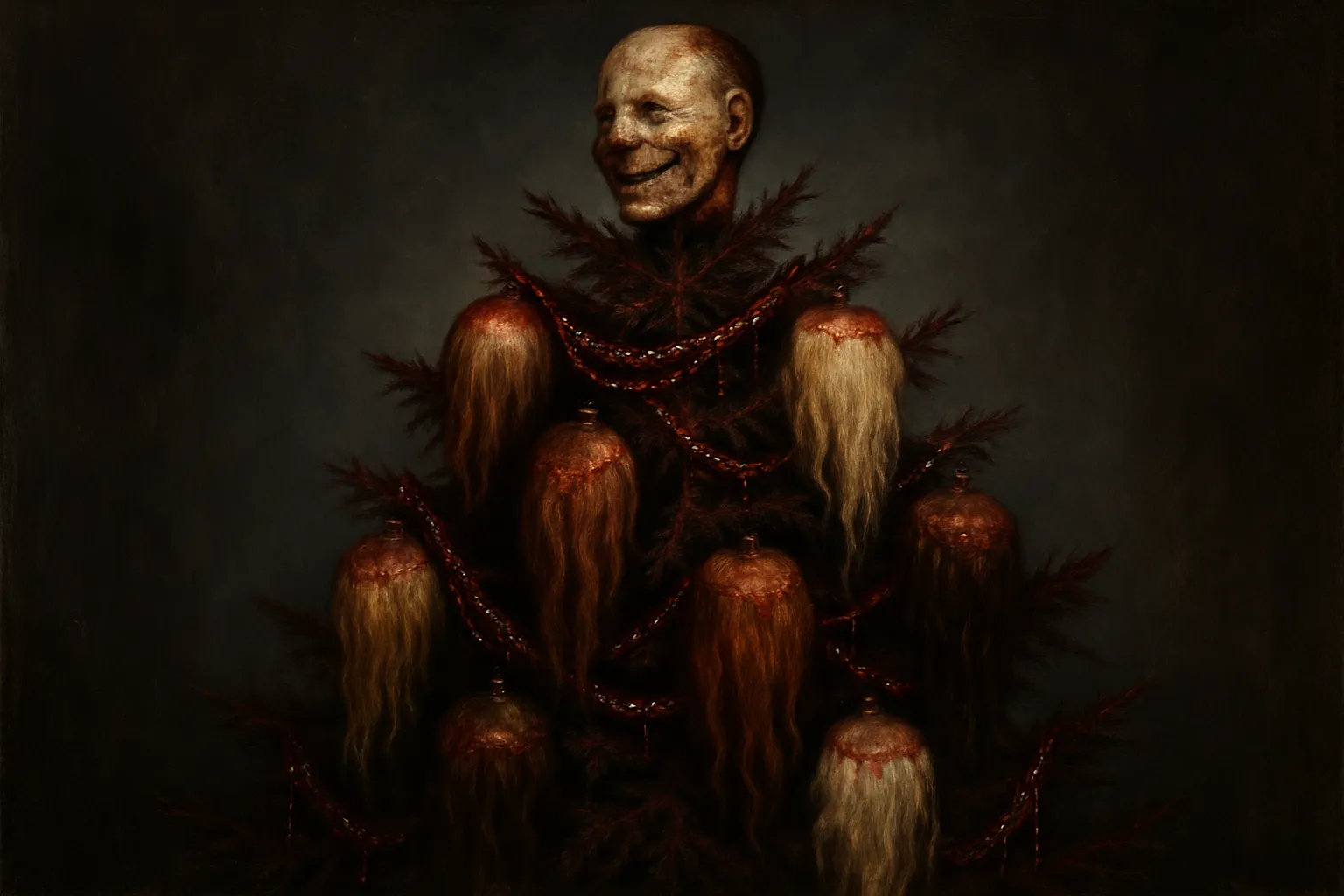
The Redskin Tree stood finished, a towering monument of festive obscenity. It was magnificent in its depravity. The crimson needles were no longer visible, buried under the weight of hundreds of freshy, dripping trophies.
Instead of shimmering tinsel, wet ribbons of intestinal lining were draped in elegant spirals from the top to the base, glistening under the gallery lights. Where colorful bulbs should have hung, we had pinned the scalps of the townspeople. My mind reeled through a haze of interconnected nightmare dreams—the faces of the people these belonged to blurred into a singular, agonizing scream. There were no individuals anymore, just a collective offering. I saw a cluster of bright blonde tresses hanging like golden bells on the lower branches; the deep brunette scalps of our neighbors were clustered in the middle like dark, heavy fruit.
Each scalp was still attached to a ragged circle of skin, the edges serrated from our dull knives. They weren't just hung; they were displayed. We had used the upholstery tacks to pin them flat against the boughs, so the hair cascaded downward like weeping willow branches. The salt-and-pepper scalp of the night watchman was there, his silver hair matted with the gray-white flecks of his own skull.
The "ornaments" we had found in the box were gone. At the very top, where the iron star should have been, sat a grotesque mockery of the town's heritage: the severed head of a local, his face painted and carved into the shape of the Redskin mascot. It sat impaled on the trunk, eyes wide and milky, staring down at us with a frozen, silent judgment. The blood ran down the trunk from the neck in a steady, thick cord, pooling at the base like a deep red tree skirt. The blood was so thick it had begun to coagulate, creating a jagged, ruby crust over the floorboards.
I looked at my hands. The skin was stained so deeply I knew it would never come clean. The under-nail beds were packed with the biological debris of my neighbors. I could finally see it—not just the blood of the people we had murdered tonight, but the invisible, ancient stain of the ground we stood on.
The "Founders" hadn't just possessed us; they had shown us who they really were. They were the ones who saw a forest and saw only timber; who saw a life and saw only a resource to be harvested for their monuments. And as I heard the first police sirens wailing in the distance, I realized the most terrifying part: the hunger in my mind wasn't entirely gone. I looked at the tree, at the rhythmic swaying of the hair in the museum's draft, and for a fleeting, sickening second, I thought it looked beautiful. It looked like home.
Comments
Post a Comment