Abstract
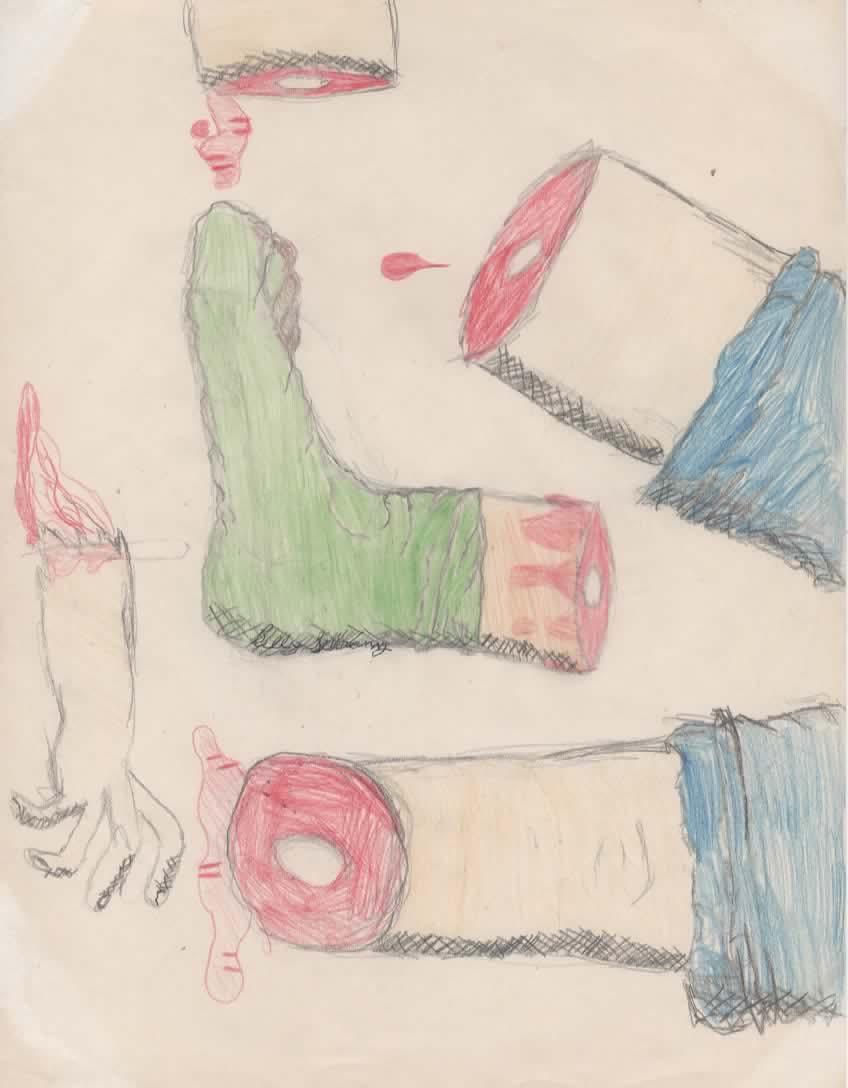
This paper mobilizes schizoanalysis (Deleuze & Guattari, 1972/1980) to examine the drawing Body Parts Colored Pencil as an a-signifying assemblage rather than a symbol to be decoded. Treating the artwork as a desiring-machine, we chart the flows and breaks of non-Oedipal desire that compose what I call an Affective-Archive: a machinic retention of intensities that persists outside narrative memory and resists clinical capture. Drawing on production data provided by the artist (motivational “inputs” such as the wish to impress a peer, the affects of “teenage angst” and “silly energy,” and the long-term physical retention of the work), I argue that the piece executes a successful deterritorialization from both the stratified social plane (professional identity, normative adolescence) and the dominant symbolic regime of art therapy, which tends to read images through Oedipalized, diagnostic codes. In dialogue with contemporary readings of desiring-production and the Body without Organs (BwO)(Kubala, 2023; Olivier, 2017, pp. 46–66; O’Sullivan, 2012, pp. 169–202; Vorobyeva, 2024), I demonstrate that Body Parts Colored Pencil establishes a victorious line of flight against therapeutic reterritorialization precisely by insisting on its own mode of production, its own “contract,” and its own a-signifying logic of presence over interpretation. The artwork thus stands as a paradigmatic case of clinical deterritorialization: it does not heal by confessing a latent trauma but by escaping the very interpretive grid that would convert it into a symptom.
1. The Beginning: Production and the Flow of Desire
Schizoanalysis, as developed by Deleuze and Guattari, demands that we abandon the hermeneutic question “What does the artwork mean?” in favor of the machinic question: “What does it do, what does it produce, and with what does it connect?” (Deleuze & Guattari, 1983). Desire is not understood as lack but as production—a network of desiring-machines coupling and decoupling in concrete assemblages(Kubala, 2023; Vorobyeva, 2024). The subject is not the origin of these processes but a derivative effect, a kind of “spectral” crystallization of flows(Olivier, 2017, pp. 46–66).
In this sense, Body Parts Colored Pencil is not an object awaiting interpretation but a local configuration in a larger machine: the adolescent social field, the crush, the corridor, the paper, the colored pencils, the later clinical setting, and now the analytic reflection. The work is an event of desiring-production, an assemblage in which bodies, tools, and affects enter into a provisional composition(O’Sullivan, 2012, pp. 169–202). Our task is to map these flows and breaks without reducing them to an Oedipal narrative or diagnostic sign.
1.1. Assemblage Initiation: Deterritorialization Against the Stratified Social Plane
At the moment of its production, the artist inhabits a particular stratified social plane: that of adolescence, peer hierarchies, emerging sexuality, and—later in life—professional identity (“the professional persona suggested by LinkedIn data”). On this plane, subjectivity is coded according to recognizable molar categories: student, professional, client, patient, “creative,” “well-adjusted,” and so on. Deleuze and Guattari call this a stratum: a relatively stable organization of flows that imposes a certain image of the body and of subjectivity (Deleuze & Guattari, 1987).
The decision to make the drawing is itself a moment of deterritorialization: desire slips out of the pre-given tracks of schoolwork, family expectation, or therapeutic compliance and invests a new circuit—impressing a peer through art. Contemporary interpreters of desiring-machines emphasize that such moments mark a refusal of a pre-constituted “human nature” in favor of flows and cross-sections of desire that cut across individual and social boundaries(Vorobyeva, 2024).
1.1.1. Non-Oedipal Coupling: Desire for the Peer as Social Vector
According to the production input, the initial motivational vector was the desire to impress a peer (a crush). Crucially, this is not structured as a displaced desire for a parental object nor framed in the familial coordinates central to Freudian Oedipal logic. It is not “mother/father” but “peer/social field.”
Deleuze and Guattari explicitly criticize psychoanalysis for “reducing desiring-production to the parameters of the family triangle” (Deleuze & Guattari, 1983). Clinical literature informed by schizoanalysis underscores that desiring-production can and often does bypass the family romance entirely, moving directly through social, institutional, and technological assemblages(Kubala, 2023; Olivier, 2017, pp. 46–66). Here, the adolescent crush operates not as an Oedipal substitute but as a social relay: desire couples the artist, the body image, the drawing tools, and the imagined gaze of the other student into a circuit.
This is a non-Oedipal coupling: the drawing machine composes itself in relation to a peer-field and an anticipated social response, rather than to a repressed family drama. Interpreting the work primarily through the lens of parental figures or childhood trauma would already be a clinical re-territorialization—an attempt to drag the flows of desire back onto the familiar terrain of the Oedipus complex.
1.1.2. A-Signifying Intensity: Teenage Angst and Silly Energy
The artist identifies “teenage angst” and “silly energy” as the primary affective inputs, while also indicating the absence of narrative memory flow and somatic memory during the drawing process. That is, there was no conscious attempt to “work through” a particular incident, injury, or trauma.
This constellation maps closely onto what Deleuze and Guattari call a-signifying semiotics: sign-systems that operate not by representing a content but by directly modulating intensities and relations (Deleuze & Guattari, 1987). Vorobyeva (2024) stresses that desiring-machines detach desire from a unified “I,” dispersing it into flows and partial processes that do not have to symbolize a personal narrative(Vorobyeva, 2024). Likewise, Kubala (2023) shows that under schizoanalytic perspectives, clinical processes can be oriented around material intensities and experiences rather than around the recovery of an origin-story or “mystical experience” as the ultimate referent(Kubala, 2023).
“Teenage angst” here is not a story but a collective affect: a diffuse, shared atmosphere of adolescence. “Silly energy” functions as a speed vector, indicating a certain tempo and style of coupling. Together they define an affective climate rather than symbolizing a specific biographical event. The production is driven by intensities—grades of excitement, restlessness, the thrill of possibly impressing someone—not by the need to encode a repressed episode.
Thus, from the outset, Body Parts Colored Pencil functions as what Deleuze and Guattari would call a desiring-machine oriented toward production of intensity, not re-presentation of trauma.
2. The Middle: The Break Circuit and Active Retention
The heart of the schizoanalytic reading lies in how the flows of desire are broken and how this break is inscribed. For schizoanalysis, breaks are not merely losses or castrations; they are productive operations—points where one flow is cut and another is initiated (Deleuze & Guattari, 1983; 1987).
In the drawing, the severed limbs, the rings of flesh at the cut sites, and the chromatic contrasts are all components of what we can call the break circuit: the concrete, material inscription of a deterritorialization of the body.
2.1. Deterritorializing the Organism: OwB and the Liberation of Partial Objects
Deleuze and Guattari oppose the organism—the socially coded, functional totality of the body—to the Body without Organs (BwO), a plane on which organs and functions are disarticulated and recomposed (Deleuze & Guattari, 1983; 1987). The BwO is not literally a body without organs but a perspective in which organs cease to be subordinated to a unitary subject or to biological utility.
Olivier (2017) reconstructs this notion to show how, for Deleuze and Guattari, subjectivity becomes “spectral,” emerging from the dynamic interplay of flows and partial objects rather than from a centered ego(Olivier, 2017, pp. 46–66). O’Sullivan similarly emphasizes that desiring-machines and BwO-operations offer a “speculative production of subjectivity” where bodies are rearranged according to aesthetic and affective logics rather than pre-given identities(O’Sullivan, 2012, pp. 169–202).
In Body Parts Colored Pencil, as described, we see an OwB state—an observed reality of severed limbs rendered with a peculiar mix of playfulness and intensity. Hands, feet, and legs appear as autonomous units, disconnected from a whole figure, floating or arranged in space without an organizing torso or head.
The organism is not the body, but a stratum on the body of nature; it is that which life sets against itself in order to limit itself. (Deleuze & Guattari, 1987)
The drawing performs precisely this operation: it breaks the organism.
2.1.1. Partial Objects in Connective Synthesis
In schizoanalytic terms, these limbs are partial objects: not representations of a mutilated person but functional units in a connective network of desire. They link with each other, with the crush’s anticipated gaze, with the artist’s hand, with the color palette, and—later—with clinical discourses. Their “severed” status is not primarily a sign of loss or trauma; it is a sign of liberation from the tyranny of the integrated organism.
Vorobyeva (2024) underscores that desiring-machines fragment the anthropological “I” into flows and components, thereby deconstructing human nature as a fixed essence(Vorobyeva, 2024). In this light, the severed limbs are not symptoms of a damaged self but demonstrations of a self already understood as a composition of detachable, re-combinable parts.
2.1.2. The Stratum of the Sock: Clothing as Residual Code
The presence of clothing—the denim and a green sock—marks another crucial layer of the assemblage. Clothing here functions as strata of social code: jeans and socks belong to a recognizable social body (“teenager,” “casual,” “everyday body”) and thus index the organized, socially legible organism.
Yet in the drawing, these garments adhere not to an integrated person but to deterritorialized fragments. The sock is on a disembodied foot, the denim on isolated legs. The social code is thus displaced from the coherent person onto the partial object. We can say that the BwO “wears” the strata rather than being fully captured by them.
This produces a double effect:
The social codes (clothing, style, legibility) remain present but no longer totalizing.
The viewer is forced to confront the materiality and autonomy of limbs beyond the reassuring figure of the whole person.
Rather than signifying a victim of violence in the usual symbolic sense, the drawing suggests an experimentation with how much of the organism can be stripped away while still maintaining affective intensity and playful coherence.
2.2. The Break Circuit: Severance Rings as Inscription Surface
The vivid red/pink rings around the severed areas operate as the visible inscription surfaces of the break. They are not simply “wounds” but markers of an operation that cuts the flows of the organism and re-routes them onto the paper.
For Deleuze and Guattari, the BwO is constituted by such cuts and inscriptions: surfaces on which intensities are recorded and re-directed (Deleuze & Guattari, 1983; 1987). Kubala (2023) notes that, in schizoanalytic perspectives, the recording of intensities is crucial: what matters is not what the image means, but how it modulates and preserves particular affective and energetic patterns(Kubala, 2023).
2.2.1. Color as Chemical Intensity: Green/Red Coupling
The chromatic dialogue between the green sock and the reddish-pink flesh is itself an a-signifying operation. Green and red are complementary colors; their juxtaposition produces a visual vibration, a physiological intensity in the eye. This resonates with Deleuze and Guattari’s insistence on “chemical” or “material” semiotics—systems in which sign-effects are generated by physical interaction and intensity, not by representational content (Deleuze & Guattari, 1987).
The green/red coupling sustains the speed vector identified by the artist as “silly energy.” The cuts do not slow the scene down into solemn horror; instead, they accelerate it into a kind of cartoonish gore, maintaining a ludic register. The break is productive, not paralyzing.
2.2.2. The Cut as Production, Not Castration
Classical psychoanalysis might be tempted to read the severed limbs as a manifestation of castration anxiety, bodily fragmentation associated with trauma, or a displaced expression of violence. Schizoanalysis, by contrast, insists that cuts are primarily productive: they connect one flow to another.
As Deleuze and Guattari argue,
Desiring-production is immediately consumption and recording, without any sort of mediation, and no sooner is it produced than it is consumed, and no sooner is it consumed than it is recorded. (Deleuze & Guattari, 1983)
The red rings show exactly this tripartite process:
Production: the artist draws the cuts.
Consumption: the artist and imagined peer enjoy the silly, shocking, playful quality.
Recording: the cuts remain inscribed on the paper as vivid color.
The break is not a trace of lack but a record of having cut—the proof of an operation carried out by the desiring-machine of the artwork. The drawing thus leans toward a Guattarian “cartography” of intensities rather than toward a Freudian archaeology of hidden causes(Kubala, 2023).
2.3. The Affective-Archive as Continuous Production
An archive, in the conventional sense, is a repository for past documents, a system for storing and organizing dead traces. The Affective-Archive proposed here is something quite different: it is a machinic system for retaining intensities across time without converting them into narrative memory or fixed meaning.
2.3.1. Active Retention: The Work as Long-Term Machine
The artist notes that they have “still [got] these things” decades later. This physical retention is not trivial. It indicates that the drawing is not an expendable artifact but has been maintained as a material node in the artist’s life.
Schizoanalytic and Deleuzian commentators have emphasized that desiring-machines can operate across long temporal scales: an artwork, for example, can continue to affect and reconfigure subjectivity far beyond its initial creation(Kubala, 2023; O’Sullivan, 2012, pp. 169–202). The persistence of the drawing indicates that its intensities remain live; it is not simply an object of nostalgia but a functioning segment of the artist’s BwO.
In this sense, the artwork is an Affective-Archive: it continually reactivates the original speed vectors (silly energy, teenage angst) whenever it is encountered, without requiring a recollection of a specific story. It stores not “what happened” but how it felt, in an a-signifying register.
2.3.2. Reflexive Discharge: Contemporary Analysis as New Flow
When the artist describes the current analytical engagement with the work as “a bit of a discharge,” this indicates that the archive is not frozen. It still produces new flows—now of theory, reflection, critique.
This is echoed in contemporary schizoanalytic work that views subjectivity as always in process, with past assemblages capable of generating new configurations in the present(Olivier, 2017, pp. 46–66; O’Sullivan, 2012, pp. 169–202). The drawing is thus not recollected as a static memory but encountered as an active machine that “demands” to be thought, written about, and re-inscribed in new discursive fields (academic, clinical, personal).
The Affective-Archive, then, is a continuous production:
It holds intensities without pinning them to a single interpretation.
It re-enters new assemblages (such as this paper, or a therapy session) as an agent of further deterritorialization.
3. The End: The Final Break and Clinical Victory
If the artwork is a desiring-machine, the clinic is another machine—often an Oedipalizing one. Art therapy, in its dominant forms, has tended to treat images as symbolic texts expressing unconscious conflicts, especially those organized around family dynamics and trauma. While this approach has its uses, from a schizoanalytic view it risks capturing the artwork in a pre-given grid of meaning, thereby shutting down its lines of flight.
The question, then, is whether Body Parts Colored Pencil is captured by the clinical interpretive machine or whether it effects a final break that secures its autonomy as a deterritorializing assemblage.
3.1. The Clinical Apparatus as Stratifier: Threat of Re-Territorialization
The art therapy setting is not neutral. It is a disciplinary space populated by diagnoses, treatment goals, institutional expectations, and implicit norms about what counts as “healthy expression.” In such a context, severed limbs, bright fractures of flesh, and playful gore are tempting objects for pathologizing interpretation:
Is this evidence of unresolved trauma?
Does it signify self-harm ideation?
Is it a displaced representation of family violence?
Schizoanalytic theory has long warned that psychoanalytic and therapeutic practices often serve as stratifying machines, reinscribing desiring-production into Oedipal and normative coordinates (Deleuze & Guattari, 1983)(Kubala, 2023). Kubala (2023), for instance, criticizes the way psychedelic-assisted therapies privilege “mystical experience” as a normative telos, subordinating diverse unconscious processes to a single, idealized form(Kubala, 2023). A similar critique applies to art therapy when it privileges “insight,” confession, or coherent narrative integration as universal goals.
To read Body Parts Colored Pencil only as a symptom of trauma would be to reterritorialize its a-signifying intensities onto the molar terrain of pathology. The clinical apparatus threatens to override the artwork’s own law of production with its diagnostic law.
3.2. Contractual Resistance: The Artwork’s Self-Assertion
The key datum here is the artist’s insistence on a kind of contract—a demand that the clinical relationship be structured on terms that respect the autonomy of their assemblages and reject certain forms of transference or interpretive imposition. When this contract cannot be honored, the artist rejects the setting.
This refusal can be read schizoanalytically as a final break—a decisive line of flight from the clinical stratification machine. Rather than accepting the role of patient whose images are decoded by the expert, the artist insists that the artwork itself is a lawful machine, a BwO with its own organizing principles.
Olivier (2017) shows that in Deleuze and Guattari’s account, the subject emerges not as a pre-given center but as a “spectral” effect of processes that are themselves extra-personal(Olivier, 2017, pp. 46–66). From this angle, the artist’s resistance is not a mere defense mechanism; it is an effect of the artwork’s own machinic consistency. The drawing “insists” that it not be reduced to a symbol of lack.
The unconscious is not a theater, but a factory. (Deleuze & Guattari, 1983)
To treat Body Parts Colored Pencil as a confession staged for an interpretive audience is to return to the theater. The contract, by contrast, affirms the factory: it insists that what matters is how the machine works, not what story it tells.
Thus, the refusal of imposed transference and the demand for different contractual terms constitute the artwork’s clinical victory. The desiring-machine of the drawing survives encounter with the therapeutic apparatus without being absorbed into its Oedipal code.
3.3. Implications for Therapeutic Practice: From Interpretation to Flow-Mapping
If we take this case seriously, it has significant implications for art therapy and related clinical practices. It suggests that a schizoanalytic flow-mapping approach may sometimes be more appropriate than a strictly symbolic-interpretive one.
Flow-mapping would involve:
Tracing Desiring-Production
Asking: What flows of desire, affect, and social relation does this artwork connect? How does it couple bodies, spaces, tools, and others? This resonates with Guattari’s own call for “cartographies” of subjectivity rather than structuralist decoding(Kubala, 2023; Olivier, 2017, pp. 46–66).Respecting A-Signifying Operations
Taking seriously that colors, cuts, forms, and repetitions may operate as modulations of intensity rather than as symbols in need of translation.Allowing for Non-Oedipal Logics
Remaining open to the possibility that desire is organized around peers, institutions, technology, or collective affects, and not primarily around the familial triangle.Honoring the Affective-Archive
Recognizing when an artwork functions as an active archive of intensities that has its own temporality. Rather than trying to “resolve” or “exhaust” the piece through interpretation, the therapist can support its continuing productivity for the client.
Denikin’s (2021) critique of certain performance theory concepts (such as “liveness” and “energy exchange”) and proposal of “choragraphic communication” as a framework for participatory practices is suggestive here(Denikin, 2021, pp. 139–170). He emphasizes individual and collective “generation-test of the possible” and “co-joint transformation of meaning-making”(Denikin, 2021, pp. 139–170)—ideas that align closely with a schizoanalytic vision of therapy as experimental co-composition, not decoding. Art therapy informed by such a perspective would see its task as facilitating new assemblages and flows rather than pinning images to fixed meanings.
In this light, Body Parts Colored Pencil demonstrates that an artwork can successfully maintain its a-signifying, deterritorializing function across decades and through clinical encounters, provided it is allowed to insist on its own machinic logic.
Conclusion
Body Parts Colored Pencil is not a symptom in need of interpretation but a desiring-machine that has produced, and continues to produce, an Affective-Archive of intensities: teenage angst, silly energy, playful dismemberment, chromatic vibration. By fragmenting the organism into partial objects, displacing social codes onto a BwO, and recording cuts as productive breaks rather than wounds of lack, the artwork performs a schizoanalytic deterritorialization of the body and of subjectivity.
Over time, its persistence as an object retained and revisited shows that it functions as an active archive rather than as a dead trace. In the clinical setting, its machinic consistency enables a final break: a refusal of Oedipalizing interpretation and a demand for a different contract of engagement.
Through this case, we see how schizoanalysis can inform a rethinking of art therapy—not as a practice of decoding latent meanings, but as a cartography of flows and assemblages. The therapeutic task, from this perspective, is not to “translate” the drawing into a story of lack but to accompany and amplify its lines of flight. In doing so, the clinic itself can be deterritorialized, becoming less a machine of normalization and more a space for the speculative production of subjectivity(Kubala, 2023; Olivier, 2017, pp. 46–66; O’Sullivan, 2012, pp. 169–202).
References
Alexander, J., & Smith, P. (1996). Social science and salvation: Risk society as mythical discourse. Zeitschrift für Soziologie, 25, 251–262.(Alexander & Smith, 1996, pp. 251–262)
Deleuze, G., & Guattari, F. (1983). Anti-Oedipus: Capitalism and schizophrenia (R. Hurley, M. Seem, & H. R. Lane, Trans.). University of Minnesota Press. (Original work published 1972)
Deleuze, G., & Guattari, F. (1987). A thousand plateaus: Capitalism and schizophrenia (B. Massumi, Trans.). University of Minnesota Press.
Denikin, A. A. (2021). Criticism of certain provisions of the performance theory by Erika Fischer-Lichte (on the example of participatory performances). [Conference paper].(Denikin, 2021, pp. 139–170)
Guattari, F. (2013). Schizoanalytic cartographies (A. Goffey, Trans.). Bloomsbury.
Kubala, P. (2023). Songs of life: Psychedelic-assisted psychotherapy and Deleuze and Guattari’s “desiring-production.” Deleuze and Guattari Studies.(Kubala, 2023)
Olivier, B. (2017, February 24). The subject: Deleuze-Guattari and/or Lacan (in the time of capitalism)? [Conference paper].(Olivier, 2017, pp. 46–66)
O’Sullivan, S. D. (2012). Desiring-machines, chaoids, probe-heads: Towards a speculative production of subjectivity (Deleuze and Guattari). [Conference paper].(O’Sullivan, 2012, pp. 169–202)
Vorobyeva, A. (2024). Deconstruction of human nature
Comments
Post a Comment