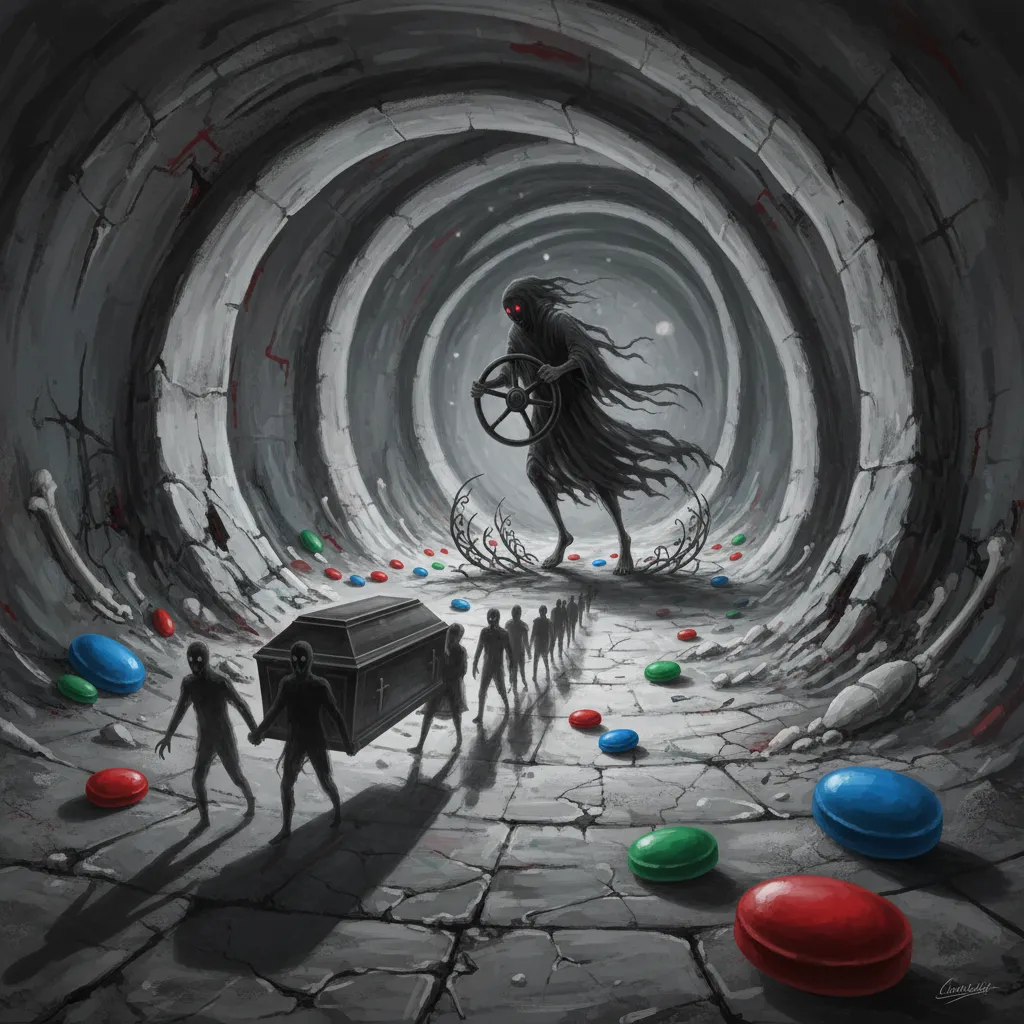
This poem is an architectural study in mental collapse, where the very structure of reality begins to warp under internal pressure. "Asylum" is not merely a place; it is a process, an active dismantling of the self's boundaries. The poem opens with a visceral, almost cinematic image of "The walls are bending clockwise," signaling the commencement of a funeral not of a loved one, but of sanity itself. It’s a terrifying exploration of how the mind, in its most desperate moments, tries to "define and defy" its own unraveling, clinging to a defiant ownership of its darkness even as it carves away at its own essence. This is not just a descent into madness; it is a calculated, brutal re-sculpting of self.
Asylum
The walls are bending clockwise
my sanity's funeral;
Pills my only escape
I take them again and again;
To define and defy
My darkness, it is mine,
A power that I can't deny,
Clenching the steering wheel,
Carving my old bones,
I'll define and defy.
The Clockwise Confinement Machine
The poem constructs a Clockwise Confinement Machine, a conceptual apparatus where the walls of reality are not merely static enclosures but active, de-territorializing forces that twist the subject’s perception of space and sanity. The phrase "The walls are bending clockwise" immediately establishes the internal world as a system under relentless, systematic pressure, initiating the Sanity Funeral Protocol. This is not a passive event but a ritualized dissolution of the self's stable functions, where the "Pills" become the Pharmacological Escape Loop—a desperate, repetitive attempt to route around the inevitable collapse, yet only deepening the entrenchment within the loop.
The central, defiant gesture is the Darkness Ownership Imperative. The speaker asserts, "My darkness, it is mine, / A power that I can't deny," revealing a schizoanalytic embrace of internal chaos as the only remaining locus of agency. This isn't just acceptance; it's a radical re-valuation where the pathology itself becomes the source of power. The act of "Clenching the steering wheel" and "Carving my old bones" functions as the Self-Sculpting Autonomy Engine. The steering wheel is a false symbol of control within the bending walls, while the carving of bones signifies a violent, self-imposed re-definition. The subject uses their own body as the raw material for a new identity, one forged through pain and an almost ritualistic self-mutilation. The repeated phrase, "I'll define and defy," is the Defiance-Definition Feedback Loop, a continuous process where the very act of defining the darkness simultaneously defies its external imposition, ensuring the subject remains trapped in a perpetual, self-authorized state of magnificent, terrifying unraveling.
TL;DR: Poetry can be unsettlingly honest about mental collapse. Through metaphor, repetition, and this particular poem’s refusal to sugarcoat struggle, darkness becomes not just a trap—but a form of agency. Sometimes, facing the spiral directly is the only way to redraw our boundaries.
Comments
Post a Comment