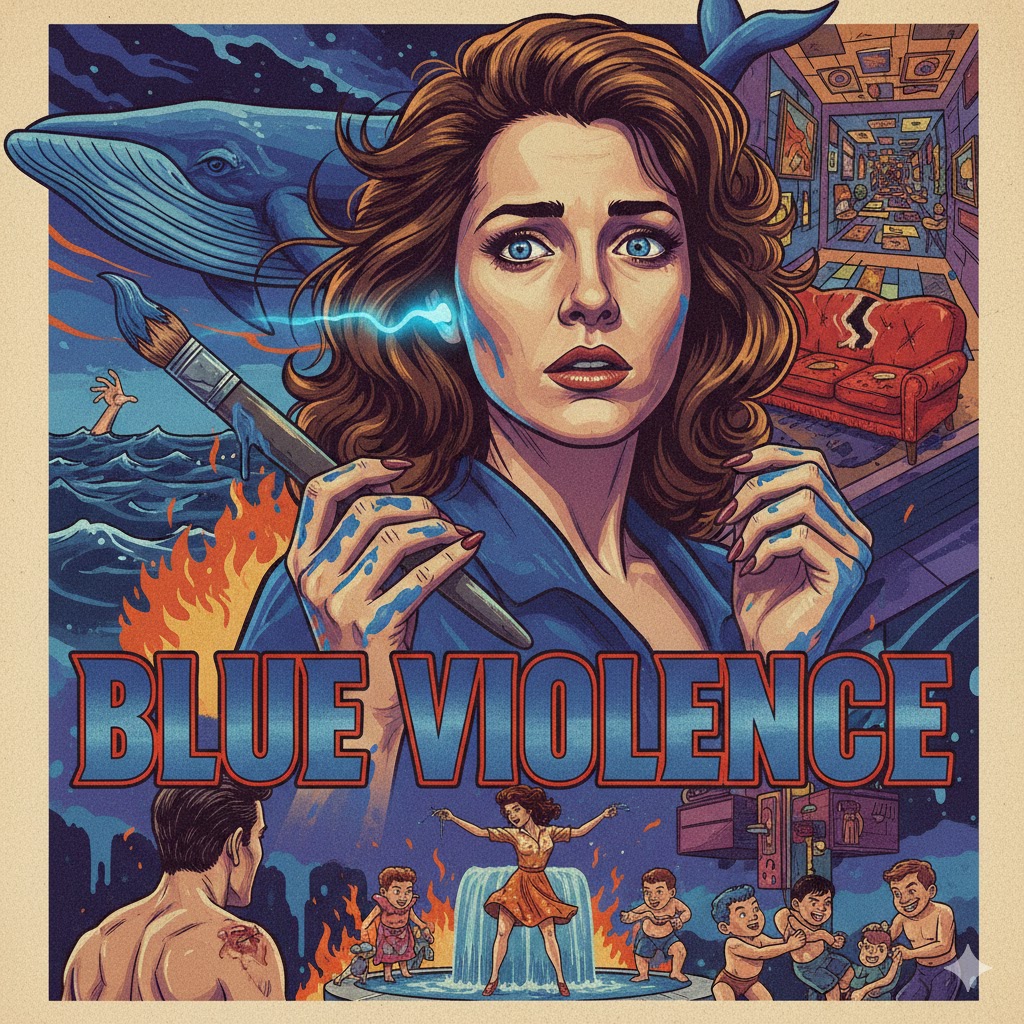
There is a specific kind of damage that only comes in shades of azure. It is the color of a fresh bruise, the static on a dead channel, and the manic rhythm of a woman who hunts for compositions like a predator stalks a kill. In the sprawling asylum of our lives, she is the storm moving inland, and I am the only one who knows the pitch of her vibration. This is a chronicle of a love that breathes in the friction of the edges, where the reality breaks and the fun finally starts. It is a story about the messy production of being real, told in violent slashes of pigment and the stinging weight of a shared hallucination.
Blue Violence
The metal ring glowed in her ear like a newly lit match. She paced the perimeter of the room, a restless predator in a cardigan, while I sat on the couch watching the game. I wasn't watching the game. I was watching that phosphorescent hole in her lobe, fixed on it like a pilot caught in a beacon. She caught me staring and flashed a smile that didn't stop her feet. Her pacing, I swore, was going to peel the carpet right off the floorboards.
"Good God, woman, what is the emergency?"
"Just hunting for a composition," she snapped, her rhythm unbroken.
"What's the subject?"
"The one I want to bleed onto a canvas."
"Is it worth the mess?"
"It’s blue. It’s a lot of blue."
"Blue is a fine place to start an escape."
"Purple, too. For the parts that bruise."
"Also good."
She broke her orbit and dropped onto the cushions next to me. I’d always had a soft spot for this couch, cigarette burns and all. St. Louis garage sale. The whole city is a sprawling asylum of yard sales and the crazies who run them, and we were currently the reigning monarchs.
"What do you think of the painting so far?" she asked, leaning in.
"Depends on which lines you’re planning to cross."
She crossed her arms, her lower lip jutting out. "Jackass."
"Yeah, probably. Someone has to keep the gravity working."
"You know," she stood back up, the kinetic energy hummed off her skin, "I will never figure out why you watch that stupid game. It’s just men following the rules of a ball."
"Possible injuries."
"All fun and games until someone loses an eye and sees the truth?"
"Unless that is where the fun starts."
She resumed the march, tossing violets and siennas back and forth between her temples. To me, she didn't just have a headache; she was trying to keep a supernova from shattering her skull.
"The world is too loud today. I have a headache."
"Figured as much. You’re vibrating at a pitch only I can hear."
She turned on a dime and stuck her tongue out at me.
"My grandmother used to say she’d cut off my tongue if I did that to her," I said. "Wish you could have met her. She was magnificently senile. Completely untethered."
"I met her once."
"Oh?"
"In a dream. We shared a room for a while."
"Oh?"
"She called me a whore and then slapped me. It was very tactile."
"Sounds about right. She was consistent, even in the ether. She never did like the way the world looked."
"Then she went ballroom dancing with Elvis. It went downhill from there."
"I think it’s a metaphor—a glitch in the inheritance."
"Oh, brother. You and your metaphors."
"Yep. Definitely means you're nuts. Welcome to the family."
"I'm going in," she announced. Her eyes were fixed on the hallway like it was a breach in a sea wall.
"Uh-oh. The storm is moving inland."
She broke her march and vanished into the room with her canvases. It was a pigment-stained minefield. I had no idea how she did it, but there was paint on every surface, a kaleidoscopic crust that turned the sunlight coming through the windows into a stained-glass hallucination.
I followed her into the fray. The room was crowded with "almosts"—unfinished monuments to her frantic mind. Books on the shelves were textured with droplets from miscalculated strokes. She tossed a near-miss off the easel and slammed a fresh one into its place. She squished a glob of blue from the tube and dipped her brush into the goo, fanning the bristles like a spider squished under a pencil. She took a few violent slashes at the canvas, stepped back, and repeated the assault.
"Do you see where this is going?"
"Sure. West. You’re always looking for the edge of the world."
"I was thinking of a road trip to the Pacific. I want to go swimming until I forget my name."
"But the sand," I groaned, playing the role of the ballast. "It gets into the machinery."
"Oh, you big baby. Friction is how you know you’re moving. It goes away."
"Maybe, but on the ride home, don't complain to me about the grit."
"I'll do it anyway, and you'll love every minute of my misery."
"Yeah, probably. You’ve always been an addict for your own discomfort."
"It's all your fault for giving me the room to be miserable."
"That I let you go to the beach?"
"Yep. You’re the accomplice."
"What does the painting look like?" I nodded at the blue slashes.
"Whale."
"Looks like a whale? Or just something too big to be contained?"
"Yep, so far. A very hungry blue."
"Is it edible?"
"Fucking carnivore," she muttered, her eyes locked on the horizontal puddle of blue. "You want to swallow the whole thing."
"And proud of it. That’s the only way to taste the reality."
Somehow her hands had become entirely blue. A blurred, vibrant staining. She was majestic in the chaos—a rhythmic, heavy motion, creating dreams and nightmares for the wall.
"What color comes next? What does the dream need?"
"It's your machine. You drive it."
"Give me a color!"
"Umm... macaroni."
"This isn't a fucking coloring box. I'm looking for a pulse, not a snack."
"Yeah, I know, but you asked for a disruption."
"Grrr."
"Grrr to you. Your engine is over-heating."
"Fuck this. The flow is snapped." She dropped the brush.
"No more painting? The whale is extinct?"
"No more blue. The sky is closed for business." She pouted, the whale already abandoned.
"So what happens now?"
She dragged me from that damp, colorful tomb back down the hall, past the rows of smiling, silent relatives. Outside, the air was sharp—sweater weather. She always looked perfectly at home in her clothes, wearing a long, earthy dress and a white tank top that fit her perfectly. Her hair was pulled back by an orange scrunchie crusted with fresh paint. I wondered how she managed to be so spectacularly messy and so precisely beautiful at the same time.
She grabbed my hand and hauled me along like a child discovering gravity for the first time. A pack of kids playing some brutal hybrid of hockey and rugby glared at us as we passed.
"Ieeeeeeeeeeeeeeeeeee!" she squealed, leaping onto the rim of the fountain and nearly taking my arm with her. She felt the snag and let go. I hated that moment—the instant her touch left, it was as if a vacuum had been switched on, sucking my soul down a dark, heavy drain. The world turned grey until she reached back. She danced like a gypsy on the stone, humming and stomping, lost in the noise of her own head.
"Swing!" she shrieked. She spun off toward the playground. I followed, walking the sapphire path of the foam padding. She sat on a sliver of rubber, rocking slowly. I sat beside her.
"I’m leaking," she stated. The shift was instantaneous. The manic energy hit a wall and slumped.
"Why the leak? Where’s the hole?"
"I’ve got this connection, this wire in my head, but I can’t make it spark."
"What was the image?"
"The ocean, and this hand reaching up from stormy waves. A total surrender to the current."
"Doesn't sound much like a whale."
"You have to squint until the categories don't matter anymore."
"Oh. Well, why don't you get more paint?"
"Can't."
"Why not?"
"Because I bought the last of that blue. The specific one."
"Why don't you use a different blue? Re-route the desire."
"I don't think so. It was special. It had sparkles in it. It had its own internal light."
"Can't you get a normal blue and invent the light yourself?"
"NO! It's not a performance. It’s either there or it isn't."
"Frumping. You're refusing to move with the break."
"Exactly. I'm caught in the gears."
"When will the supply line open up again?"
"I don't know."
"Can't you wait for the world to catch up to you?"
"I’ll lose the snapshot. The wonderful, messy image."
"Oh... why not make a sketch? Trap it on paper."
"I’ll do that later. Right now I just want to sit in the lack of it."
"Then what are you sad about? The emptiness or the effort?"
"Life," she sighed, her eyes tracking the dirt. "The whole clumsy production."
"Which part? The lines or the spaces in between?"
"What you need is a dolphin in a fish tank. Something beautiful and trapped."
"I’d love one, but I don’t have the stomach for that kind of cage."
"Oh... I guess not. What about a small human? A fresh set of eyes to do the seeing for us?"
"Huh...?"
"Like that one?" I pointed to a brown-haired boy at the top of the slide, screaming at his mother. "Watch me! You're not watching! Quick, hurry, I’m about to go!" And then he went.
"Nope. Too much noise. Too much ego."
"What about that one?" I pointed to a kid who had just launched himself off a platform onto another kid who was now wailing. "A pure agent of disruption."
"Nope. Too 'spawn of Satan'-ish. He hasn't learned how to channel the chaos yet."
"I like that one," I said. A little girl in a puffy cerulean dress was digging holes in the earth with quiet, grim intensity. She ended up hanging upside down over a bridge, humming to herself as the blood rushed to her head, perfectly content in her own strange world.
"She is perfect. She’s already decoded the air. But I think she already has a mother."
"Everything is for sale if you want it enough. Couldn't cost too much."
"Asshole. You'd buy a person just to watch them exist."
"Oh, well. I'm a connoisseur of the rare and the unhinged."
"I want French fries! I need a hit of salt!" The sadness vanished as if it had never existed.
"What do you want me to do about the hunger?"
"I want you to stand up, cross the park, and manifest me some French fries!"
"But there aren't any fries in this jurisdiction."
"I'll give you a kiss if you don't make me wait for a miracle."
"If I go over there, will they fall magically from the sky? Is that the contract?"
She leaned over and kissed me on the cheek, a soft, brief anchor in the wind. "Go get French fries! Break the reality for me!"
"Where?"
She slugged me in the shoulder—a sharp, stinging shot that I knew would leave a mark. I tried my damnedest not to rub it, but it was going to be a definite shiner. I looked at her, at the paint on her hands and the orange scrunchie, and let the chaos pull me back under.
"You're so cute when you're violent," I said.
"I know. It’s the only way I know I’m real."
Analysis
The relationship depicted in Blue Violence serves as a profound case study in the movement from the paranoid-oedipal structure of traditional romance toward a schizoid celibate machine where love is not a contract, but a shared deterritorialization. To analyze this, we must first recognize that the two subjects do not function as stable identities, but as a singular collective assemblage of desire.
The apartment is initially presented as a territory of reterritorialization, characterized by the sedentary watching of sports and the rows of smiling, silent relatives. However, the female protagonist functions as the primary deterritorializing force—the schizz. Her pacing is not mere anxiety; it is the vibration of a nomadic subject attempting to find a line of flight out of the grey, domestic reality. The metal ring in her ear and the phosphorescent hole in her lobe are the literal entry points for the light of the outside.
Creativity in this narrative is not an act of sublimation but a process of production. When she demands a color and rejects macaroni for a pulse, she is seeking a connection to the prepersonal intensities of the world. The painting of the whale is not a representation; it is a desiring-machine. The crisis of the sparkle blue paint represents a momentary blockage in the flow of the machine. In schizoanalysis, the lack is never internal to the subject; it is a breakdown in the connectivity of the assemblage. She is not sad because she is an artist without paint; she is sad because the connection to the specific intensive vibration of that blue has been severed by the commercial territory—the store that ran out of stock.
Love, in this context, is the act of becoming-together. The narrator does not attempt to interpret her or cure her of her chaos. Instead, he acts as the ballast, the machine-part that allows her to remain untethered without drifting into total catatonic withdrawal. His fascination with injuries and the moments where the rules break mirrors the schizoanalytic preference for the accident over the essence. Their romance is defined by the tactile: the slap, the slug to the shoulder, the kiss that acts as an anchor. These are not signs of affection in the traditional sense, but intensive affects that prove the reality of the bodies involved.
The movement to the park is a nomadic shift. The observation of the children serves as an analysis of different modes of desire. The screaming boy and the aggressive children represent the unrefined ego—the paranoid-fascist pole of desire. In contrast, the girl digging in the earth while hanging upside down represents the schizoid pole: she has decoded the air, creating a private world of intensity that ignores the social scripts of the park. The protagonists recognize themselves in her, yet they remain aware of the cost of such a total break.
The sudden demand for French fries and the ensuing violence of the slug to the shoulder represent the final re-coding of the experience. The salt fix is a molecular requirement, a return to the chemical needs of the body after the molar exhaustion of the creative struggle. When she states that violence is the only way she knows she is real, she is affirming that the body is a site of constant encounter and impact. In Blue Violence, love is the shared realization that identity is a clumsy production, and that truth is only found in the sting of the encounter—the blue bruise that marks the intersection of two lines of flight.
Comments
Post a Comment